The Definitive Country Almanac: The Black Ledger — Part 1#
Kethra Almanac • Approved 19 September 2026 • drafted 19 September 2026 • Sections 1–4 (Sections 5–8 are in Part 2)
Status: approved. Briana approved the whole almanac on 19 September 2026 (the Almanac Approval Decision). Where this file calls something a proposal, read it as approved, except the open points that decision lists.
Status before approval:
- Established in earlier files, and taken as given here (proposals there too, unless the spine's canon table covers them):
- The name Black Ledger, approved by Briana (the faction roster, 15 September). The roster's role note reads "Assassins and hired military operators with hidden bases and manufacturing"; the spine carries forward only "Assassins and deniable operators. Hidden.", and so does this almanac.
- Rumoured at Unlisted (Kronos XV) and Ledger's Reach in the belt (the Who's Who). Unlisted: 24.0 million km from Kronos, a 760-day retrograde orbit, about 6 km, held by "Officially no one", and "Rumoured to be a Black Ledger cache. Ships that go looking tend not to file reports." (chapter 11). Ledger's Reach: "Not on any chart" (chapter 11). "Unlisted, if it exists", and "Unlisted's people, if any, are not counted" (the Kronos colony almanac). Both atlas entries carry the status rumoured.
- "The Black Ledger is rumoured to settle its accounts in ledger-marks: debts of favours that can be traded between members." (Chapter VI.) Chapter VI once pointed to the register for this; the register says nothing about ledger-marks, and the pointer was removed on 19 September 2026. They are Chapter VI's rumour, and are carried here as one.
- Couriers carry, in Chapter VI's words, "diplomatic bags, sealed Ilyr documents, and Black Ledger messages".
- "Black Ledger (no known flag)" (the Who's Who).
- What four powers say of it, each in its own almanac. The Assembly's Inspectorate: "Hunted", and "The Inspectorate's oldest open file: unlicensed sockets by the hundred, and no factory ever found" (the Assembly almanac). The League: "The Imperium says the League hires it. The League says the Ledger has killed its captains for Imperial money. Nobody can prove either." (the League almanac). Vesper: "Every year someone claims the Ledger buys strings from a relay clerk. The Relay Guild has never found one." (the Vesper almanac). The Free Banner Guild struck a banner that was paid to stand down in the Serrin betrayal (2306), lays the payment to the Ledger without having proved who paid, and wrote the Ledger Rule (2311) (the Free Banner Guild almanac).
- From the register: type "Covert contracting network"; its objective is to "Preserve profitable deniable work and the secrecy of its clients"; its fear is "An exposed client ledger that makes its protection promises worthless"; its leverage is "Deniable force, informants and compromised intermediaries"; its split is that "Brokers prefer durable influence; field contractors seek payment and survival". Its positions towards the Free Banner Guild, and the Guild's towards it, are used throughout. Its register entries towards the Noetic Directorate and the Hollow Compact are not used: both belong to a later era and are "Not placed on Kethra" (the spine).
- Proposal: everything else. It is built on the spine, Chapters II, IV, V and VI, chapter 11, the Kronos colony almanac, the Who's Who and the almanacs of everyone who has accused it.
- Two corrections made to earlier files (19 September 2026): the spine's S4 line listed the Ledger's Kronos foothold as a fact beside the others'; the Who's Who, chapter 11, the Kronos colony almanac and the atlas all give it as rumour, and the spine's line now says so. And Chapter VI's ledger-marks line no longer points to the register (above).
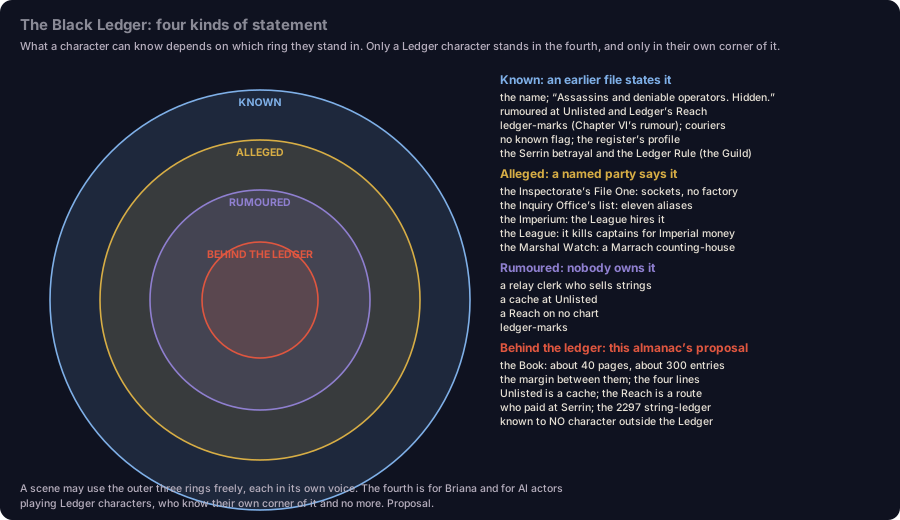
How to read this almanac. Nobody has written the Ledger's almanac from the inside. This one is written from the outside, and every statement in it is one of four kinds:
| Kind | Meaning |
|---|---|
| Known | An earlier file states it, or states that the rumour exists |
| Alleged | A named party says it. The Assembly's Accord Inspectorate, the Crown Inquiry Office, the Imperium's Office of the Marshal Watch, the League's captains, the Guild's Banner Court and Vesper's Relay Guild all keep files, and they disagree. |
| Rumoured | Nobody owns it |
| Behind the ledger | Passages under this heading are this almanac's proposal for what is actually true. They exist for Briana, and for AI actors playing Ledger characters, who know their own corner of it and no more. No character outside the Ledger knows any of it, and no scene may give it to them. |
Every place named here is on the interactive Atlas: Unlisted on the Kronos map, Ledger's Reach on the Cinderbelt map, and three sites on Kethra: two alleged, marked rumoured, and the Serrin train, the site of a known event, marked proposal. The generated Register of the Black Ledger lists them.
Section 1: National Overview & Identity#
Official Name & Etymology#
- Formal name: none. It has no charter, no seat and no entry in any register. "A company in the Crown exists by royal charter, registered with the Office of Trade, with limited liability." (Chapter II.) This one does not exist.
- The name it is given: the Black Ledger. Proposal: it is the title of a Crown Inquiry Office file opened in 2231; what the file says is alleged. In Aletheia's counting-houses a black ledger was the book of debts kept off the Weave, where "Most transactions go through Weave accounts, the digital bank ledger" (Chapter VI): the debts a house did not want recorded. The Office used the phrase for three deaths whose payment it could find nowhere, and the name attached itself to whoever had been paid.
- Short forms: the Ledger everywhere; on the Line, a killing everyone has heard of and no one witnessed is "a by-word death", from the Line courts' rule that "by eye" is testimony and "by word" is rumour (Chapter IV, the Line almanac).
- Name check (naming principles). The name comes from Aletheia's counting-house slang. The structure proposed in Part 2 (pages, entries, accounts, postings) is modelled on the Saltline Exchange's clearing practice (the Line almanac). Different sources.
Not the Ledger. Four names to keep apart from it, because characters confuse them and files must not:
| Name | What it is | Source |
|---|---|---|
| The Ledgers | An Imperial political current: the industrial patrons and corridor companies, with a licensed paper, the Corridor Gazette | The Vardane almanac |
| The Serell Ledger | A Cordale finance and shipping newspaper | The Lesser Crowns almanac |
| The string-ledger | Vesper's Traffic Office record of every relayed message's sender, recipient and time | The Vesper almanac |
| Serell | Cordale's port, where the 2262 socket ring was broken. Not Serrin, the Imperial gulf holding where the 2306 betrayal happened. | The Assembly, Lesser Crowns and Guild almanacs |
What others call it:
| Who | Name | Meaning |
|---|---|---|
| The Crown Inquiry Office | "the Ledger" | The file's title, and the Office's oldest |
| The Accord Inspectorate | "File One" | "The Inspectorate's oldest open file" (the Assembly almanac); that the Inspectorate numbers it first is this almanac's proposal |
| The Office of the Marshal Watch | "the League's hirelings" | "The Imperium says the League hires it" (the League almanac) |
| The League's captains | "the Imperium's knife" | "The League says the Ledger has killed its captains for Imperial money" (the League almanac) |
| The Free Banner Guild | "the enemy that does not sign" | The Guild almanac's own words |
| Vesper | "a story about a clerk" | "The Relay Guild has never found one" (the Vesper almanac) |
| The Line ports | "by word" | Rumour, in the courts' sense |
| The frontier | "the jar-sellers" | From the frontier idiom "He'd sell the Gift-jar" for someone who would betray anything (Chapter IV) |
| Themselves | Behind the ledger: the Book, and nothing for themselves | A page keeps a page of the Book; an entry is an entry in it |
Greeting: none. Behind the ledger: a margin and an entry who must meet, and have never met, use the Line's rudest question and the Line's word for rumour: "Whose side?" "By word." "Never ask whose side someone is on" (the Line almanac); anyone who answers the question honestly is not the person expected.
National Symbols#
| Symbol | Description | Meaning |
|---|---|---|
| Flag | None known (the Who's Who) | A flag is a claim, and the Ledger claims nothing |
| Emblem | Alleged: the black seal. The Inquiry Office's file holds nine courier pouches sealed with plain black wax, the seal of no house. | Behind the ledger: real. Black wax because every house's wax is a colour, and a colour is a name. |
| Motto | None | The register's objective is the nearest thing: "Preserve profitable deniable work and the secrecy of its clients" |
| Anthem | None | "An unsung death" is the worst fate in the songs (Chapter IV). The Ledger's dead are unsung, and the Ledger does not mind. |
| Colours | None |
The State Profile#
| Seat | None known. Rumoured: Unlisted (Kronos XV); Ledger's Reach (the belt). Alleged: a desk at the Saltline Exchange, the Counting Desk (the Inquiry Office); a counting-house at Marrach (the Marshal Watch). |
| Head | None known. Behind the ledger: none. The Book has no head. It has pages. |
| Government | None. "Covert contracting network" (the register). |
| People | Unknown. The Inquiry Office's file names eleven brokers by alias, none charged; the Inspectorate counts 214 socket convictions from one ring (2262) it attributes to the Ledger's supply (alleged). Behind the ledger: about 40 pages, about 300 entries, and perhaps 2,000 people who have knowingly taken its money. |
| Where | Wherever its clients are, and nowhere it can be found |
| Language | Whatever the page speaks. Behind the ledger: paper, in Hallspeech, because the Crown's courts read Hallspeech and no clerk looks twice at it. |
| Money | Crowns, cleared through the Saltline Exchange (alleged); ledger-marks (rumoured, Chapter VI). Behind the ledger: cinder scrip, Hearth chits and wolf-silver wherever those are the money (Chapter VI, the Kronos colony almanac). |
| Time | By courier. A Kethra–belt message is seven hours by relay (Chapter VI) and six to fourteen weeks by hull (chapter 11). The Ledger takes the weeks. |
| Standing | Not a state, not a company, and not outlawed as such: nothing outlaws what does not exist. "Hunted" by the Inspectorate for its sockets (the Assembly almanac); struck by the Guild for its money (the Guild almanac). |
Chronological Timeline#
This is the timeline of the file, not of the faction. Every row is Known or Alleged unless marked Behind the ledger.
| AL | Event | Kind |
|---|---|---|
| 2121–2158 | The Hollin Children affair: unlicensed heritable edits in private clinics, for a generation (Chapter V). The precedent for clinics that work covertly for decades. | Known |
| 2150 | The Frame Accord, and the Accord Inspectorate. A link-socket needs a state licence and an Accord registration number; "black sockets" are "a serious crime in the Crown and common in the belt" (Chapter II). | Known |
| 2154 | The Inspectorate begins entering factories, yards and clinics without leave (the Assembly almanac). Its first seizures of unlicensed sockets. | Known (the inspections); the seizures, and File One's opening this year, are this almanac's proposal |
| 2229 | The Brisk Foundry revocation: a Crown contractor fits licensed civil socket cores into weapon mounts (the Ilyr almanac). | Known. Behind the ledger: the pattern of every Book socket since. |
| 2231 | The Crown Inquiry Office titles a file "the Black Ledger": three deaths in Aletheia's counting-houses in one winter, paid for by no one it could find. | Proposal (the file, its date and the name's origin); what the file says is alleged |
| 2262 | The Serell socket ring: 214 black-socket convictions at one Tribunal, the largest ever (the Assembly almanac). None of the 214 names a supplier. | Known (the convictions); that none named a supplier is this almanac's proposal. Behind the ledger: the ring was a Book supply chain, and no entry in it had ever met a page. |
| 2279–2291 | The Corridor War. Both sides' frames are inspected at the front and no Accord conviction follows (the Assembly almanac). "The Crown has no military base in the belt" (chapter 11), and buys what it cannot send. | Known; the belt work alleged by the League and the Imperium of each other |
| 2285 | The letters: League captains raid Imperial claims on secret Crown letters that the Crown calls forgeries (the Crown almanac, the League almanac) | Known |
| 2291 | The Armistice of Saltline. The Crown's Revocation of the letters (the League almanac). | Known. Behind the ledger: the pages close the Book: no state will ever again be a standing account. |
| 2297 | The relay-clerk story, told "Every year" (the Vesper almanac), is first told at Vesper Prime; the year is this almanac's proposal | Rumoured |
| 2306 | The Serrin betrayal. A banner escorting a corridor company's train is paid to stand down for an hour; 41 die, nine of them the banner's own hands. The Banner Court strikes the banner (the Guild almanac). Who paid is unproven. | Known, as the Guild's finding |
| 2306 | Bettina Okonkwo becomes Chief Inspector (the Assembly almanac), and reopens File One | Known; the reopening is this almanac's proposal |
| 2311 | The Ledger Rule: any banner that takes the Ledger's money is struck (the Guild almanac) | Known |
| 2313 | The Requisition Bill would let the Assembly requisition "production, docks, relays and hulls" in an emergency (the Assembly almanac). A hull is a courier. | Known |
| 2314 | The present. The Serrin case's last appeal at the Banner Court (the Guild almanac). Chief Inspector Bettina Okonkwo asks the Accord Council for a warrant to search the independents' rocks for File One's factory, backed by the Crown's Chief Inquirer, Ruaridh Macphail, and is refused: the Charter's Hand reaches factories, broadcasters and clinics, not rocks. | Known; the warrant proposal |
Not on this timeline. The Kettle informers (2306), three Imperial informers who vanished at the Wick (the League almanac): no file connects them to the Ledger, "Spacing is an accusation, not a fact" (the League almanac), and this almanac makes no connection either.
Section 2: Geography & Environment#
Physical Geography#
The Ledger has no geography. It has other people's.
| Place | Kind | What the files say | Behind the ledger |
|---|---|---|---|
| Unlisted, Kronos XV | Rumoured | The outermost of the fifteen moons: a captured rock about 6 km across on a distant, tilted, retrograde orbit of 760 Earth days, 24.0 million km out; "Officially no one" holds it; "Rumoured to be a Black Ledger cache. Ships that go looking tend not to file reports." (chapter 11.) Its people, if any, are not counted (the Kronos colony almanac). | It exists. It is a cache, not a base: the Corridor War's salvage, black sockets by the crate and four frames, hollowed into the rock in 2286 by a Coalition yard crew who never knew whose money it was. A crew of thirty to fifty, all entries and never a page, rotates through it on independents' hulls, wide of Tollgate's picket (chapter 11); its Hearthport errands are run at the Dark Hour, which is "curfew, vigil, and cover" (the Kronos colony almanac). Ships that go looking do not file reports because the crew shoots first, with hands in the frames. |
| Ledger's Reach, the Cinderbelt | Rumoured | "Not on any chart" (chapter 11); population unknown | Not a place. A route: a chain of independents' rocks among the belt's 175,000 unaffiliated people (chapter 11), where entries are paid, hidden and, when necessary, closed. The atlas marker is where the Inspectorate thinks it is, and the Inspectorate is wrong. |
| The Counting Desk, Saltline | Alleged (the Inquiry Office) | A desk at the Saltline Exchange, which "clears contracts between powers that will not trade with each other directly" (the Line almanac). The Exchange says every desk is a desk. | Real, and not one desk: three pages hold Exchange seats as the traders they are, and clear the Book's money as insurance and voyage shares. |
| The Marrach counting-house, the Imperium | Alleged (the Marshal Watch) | A counting-house on Marrach's waterfront that pays the Ledger's corridor work. The Crown notes that the Marshal Watch alleges it of every counting-house in Marrach. | The Marshal Watch is right about one of them, and has never found which. |
| The Serrin train, the Imperium | Known (the deaths); the site proposal | Where the Serrin betrayal's 41 died in 2306 (the Guild almanac) | The account was a Tolvard phosphate house in a corridor-share dispute with the Serrin company. No character knows this, and the Banner Court will not find it. |
Why the belt#
- "The Crown has no military base in the belt" (chapter 11); the only law is local (Coalition and yard law, the Belt Marshal's, or the League's captains' justice), and "The 7-hour light delay makes appeals to the capital theoretical" (Chapter II).
- Black sockets are "common in the belt" (Chapter II); Hob refits "anyone's hull, no questions asked" (the League almanac); nobody asks a moth where they came from.
- The Seam: frame skirmishes every season, and "Kethra hears of each clash the day after it's over" (chapter 11). Behind the ledger: a claim jumped in the Seam is a posting; a death there is a skirmish.
- The independents: 175,000 people who "belong to no one" (chapter 11).
"Climate"#
None. Behind the ledger: the Book works the calendar all the same. Postings on Kethra are made in the red-night season, when doors are shuttered and "Waking someone by opening their shutters in the red-night season is a real offence" (Chapter III); postings at Kronos at the Dark Hour; nothing at all on the Unmapping (3 Thaw), the one day the relays are silent (the Vesper almanac), because a day of silence is a day everyone is listening.
Life and Resources#
Behind the ledger, except the quotations from earlier files.
| Resource | Where it comes from | Notes |
|---|---|---|
| Sockets | Diverted civil cores, the Brisk Foundry pattern (the Ilyr almanac); Corridor War salvage | "No factory ever found" (the Assembly almanac), because there is none. The cores are diverted before fitting, when they carry no Accord registration number: the number is given only when a licensed clinic fits one (Chapter II). About 3,000 black sockets have passed through the Book since 2154, most of them sold on; the Inspectorate's seizures (Part 2) are under a third of them. |
| Frames | A handful, never more | Every one with a hand in it. "No frame without a hand" (Chapter II): an unmanned killer is the one thing every power on Kethra hunts together, and its builders are shunned for life (Chapter V). The Book keeps the Frame Accord's first rule, a hand in every frame, because that rule is what keeps it alive; its sockets break the Accord's licensing every day. |
| Hulls | Hired from the independents; never owned | A hull is a courier, and a courier is the Book's only wire |
| Paper and wax | Aletheia | The black seal |
| People | The unrostered, the beached, the struck, the discharged, the runaway | Section 4 |
Section 3: History & Chronology#
Before the name (2121–2231)#
Killing for money is older than the Silence, and every era's assassins died unsung. What made the Ledger possible was the Frame Accord. After 2150 a link-socket without a licence was a crime everywhere and a commodity in the belt (Chapter II), and a market that a planet forbids and a belt supplies needs a broker. The Hollin clinics (Chapter V) had already shown that a covert trade could run for a generation inside a licensed one. The Inspectorate has entered factories, yards and clinics without leave since 2154 (the Assembly almanac); by this almanac's proposal, its first seizures of unlicensed sockets that year are the beginning of the file it now calls its oldest.
The file opens (2231–2278)#
Proposal; what the file says is alleged. In the winter of 2231 three people died in Aletheia's counting-houses in a month: an underwriter, a Weave-clerk and a chartered House's factor, each after a debt dispute, each by an ordinary accident. The Inquiry Office's file-keeper, Bertil Skoglund, could find no payment for any of them on the Weave and wrote across the file's cover what a counting-house calls the debts it keeps off the Weave: the black ledger. The file has never closed. Its second great entry is the Serell socket ring of 2262, 214 convictions at one Tribunal (the Assembly almanac): the Inspectorate's case that the ring's sockets came from one supplier, whom none of the 214 could name.
Behind the ledger. The ring was the Book's, and the 214 could not name a page because none had met one. That is not luck; it is the practice that became the second of the four lines (Part 2). One of the convicted, Dario Vantongeren, whose sockets were fitted in the Crown, served twenty years in Greywater Keep and wrote Two Hundred and Fourteen (2286), which says, truthfully, that he never knew who paid him.
The war (2279–2291)#
The Corridor War was fought "within the Accords" (the Assembly almanac) and, in the belt, by other means. The Crown had no base there and bought what it could not send; the Imperium, with Castellan Rock and Seamwatch (chapter 11, the Vardane almanac), is alleged by the League to have done the same. The one such purchase in the files is the Crown's: the Revoked, "League captains who say they raided Imperial claims on secret Crown letters in the war, letters the Crown calls forgeries" (the Crown almanac). A state that pays for a deniable operation and then denies the paper is the Ledger's whole market, described from the outside.
Behind the ledger. The pages were the war's brokers on both sides, and were nearly destroyed by it: a state is an account that can afford to close its brokers. In 2291, the year of the Armistice and the Revocation, the surviving pages met at Saltline as the traders they were and closed the Book: no state, ever again, as a standing account. The first of the four lines, "No account is a master", dates from that meeting.
After the war (2291–2314)#
The peace gave the Ledger its accusers. Vesper's relay-clerk story is told "Every year" (the Vesper almanac), and by this almanac's proposal was first told in 2297. The League and the Imperium accuse each other of hiring it (the League almanac), and by this almanac's proposal have done so since the Lamp Raids. In 2306 came the one case with a court: the Serrin betrayal, in which a Guild banner took money to stand down for an hour, and 41 people died in the hour (the Guild almanac). The Banner Court struck the banner, and its captain, Havel Mansour, has never named who paid him. (Behind the ledger: he never met a page.) The same year Bettina Okonkwo became Chief Inspector (the Assembly almanac). The Guild's Ledger Rule (2311) made the Ledger the only client on Kethra that the Guild will not serve knowingly, and the only one that never signs.
Behind the ledger. The Book has grown since the Armistice, and the register's split has grown with it. Pages want the Book to last: "Brokers prefer durable influence." Entries want to be paid and to live: "field contractors seek payment and survival." When an entry is caught, the page's interest is that the entry be closed, and every entry knows it. Serrin was the Book's worst posting because the account, a Tolvard phosphate house, was not closed afterwards and could not be: "The Book does not kill accounts. It keeps them." The pages have argued since about whether that line is a rule or a weakness.
The present (2314)#
The Inspectorate's oldest file is open, and its Chief Inspector wants the independents' rocks searched; the Accord Council has refused, because the Charter's Hand reaches factories, broadcasters and clinics (the Assembly almanac), not rocks. The Requisition Bill would let the Assembly requisition hulls (the Assembly almanac), and a hull is a courier. The Seam skirmishes every season. The Serrin case comes to the Banner Court on its last appeal. Behind the ledger: none of these will find the Book, and the Book knows that the one that could is the first account that talks.
Historical Rulers & Leaders#
The Eleven Aliases#
None known. What follows is alleged: the Crown Inquiry Office's list of suspected brokers, by the aliases the file gives them. None has been charged. One has sued.
| # | Alias | Where alleged | Years | What is alleged | Standing |
|---|---|---|---|---|---|
| 1 | the Underwriter | Driftmark | 2231–2260 | The first broker; the file's origin; cleared the 2231 deaths as insurance | Dead, "by word" |
| 2 | the Surgeon | The belt, place unknown | 2262– | Fits black sockets; the Serell ring's supplier | The Inspectorate's oldest name; never seen |
| 3 | the Widow | Marrach | 2270– | Keeps the counting-house | Alleged by the Marshal Watch, which alleges it of every counting-house in Marrach |
| 4 | the Notary | Cordale | 2283– | Clears belt insurance claims that pay the Ledger's contractors | A Cordale notary, Odalys Ferrant, sued the Office for naming her in 2301, and won |
| 5 | the Assayer | Cinder Hollow | 2288– | A clerk of the Crown Assay House is a broker | The Crown denies it, and has not replaced the clerk |
| 6 | the Bandsman | Hearthport | 2290– | An informer's informer: buys what the bands know | Alleged, quietly, by the Hearth Council |
| 7 | the Chandler | Saltline | 2291– | The Counting Desk | Alleged; the Exchange says every desk is a desk |
| 8 | the Factor | Serrin | 2296– | A corridor-company factor; the Serrin betrayal's cut-out | Alleged by the Guild's advocates at the Banner Court; unproven |
| 9 | the Purser | Muster | 2299– | Pays the Ledger's contractors among the hull crews between contracts | The Guild denies any broker at Muster, and has looked |
| 10 | the Lodger | The Wick | 2304– | A broker among the League's newcomers | Alleged by the Imperium only; the League calls it a slander |
| 11 | the Keeper of Accounts | Nowhere | — | The head the Office assumes must exist | Behind the ledger: there is none |
Behind the ledger. Of the eleven, six are real and five are not, and the Book has never been able to find out which six the Office believes.
Names in the file#
| Person | Dates | Why in the file |
|---|---|---|
| Bertil Skoglund | 2188–2261; file-keeper 2231–2249 | Named the file |
| Dario Vantongeren | born 2239 | Convicted in the Serell ring (2262) for sockets fitted in the Crown; served twenty years in Greywater Keep; wrote Two Hundred and Fourteen (2286) |
| Odalys Ferrant | born 2251 | The Cordale notary who sued the Office for libel (2301) and won. Whether she is the Notary is behind the ledger, and she is. |
| Oksana Petrosyan | 2262–2303 | A League captain the League says the Ledger killed for Imperial money (2303). The Imperium says her own crew did it. Nobody can prove either. |
| Havel Mansour | born 2268 | Captain of the struck banner at Serrin (2306), who has never named who paid him. Behind the ledger: the Book's one known entry, who never met a page. |
| Ruaridh Macphail | born 2259; Chief Inquirer of the Crown Inquiry Office since 2308 | Backed the Chief Inspector's request for the belt warrant (2314), which the Accord Council refused |
Section 4: Demographics & Society#
Population Metrics#
There is no census. There are counts made by other people.
| What is counted | Number | Who counts it |
|---|---|---|
| Socket convictions in the Serell ring, 2262 | 214 | The Accord Tribunal (the Assembly almanac) |
| Accord convictions a year, 2314 | about 70, of which the Inspectorate attributes about a third to File One's sockets | The Assembly almanac; the attribution alleged |
| Unlicensed sockets seized since 2154 | "by the hundred" (the Assembly almanac) | The Inspectorate |
| Dead at Serrin, 2306 | 41 | The Banner Court (the Guild almanac) |
| League captains: "the Ledger has killed its captains for Imperial money" (the League almanac) | 9, by the League's Captains' Roll (2293–2313) | The League, alleged; the Imperium denies every one |
| Relay clerks found selling strings | 0 | The Relay Guild (the Vesper almanac) |
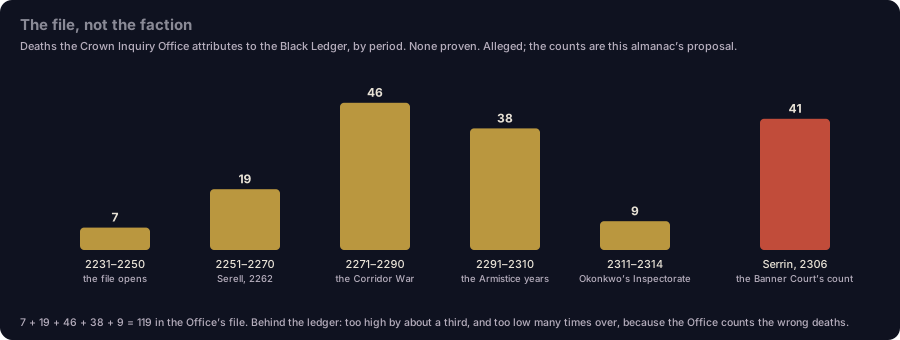
| Deaths in the Inquiry Office's file, 2231–2314 | 119, none proven | The Crown Inquiry Office, alleged |
Behind the ledger.
| Pages | About 40: Exchange traders, notaries, factors, underwriters, a surgeon, a Habitat Marshals' supply agent, a Hearthport contract engineer, a Cordale banker. Each keeps a page; a page knows at most four others. |
| Entries | About 300, hired by the posting, most of them never twice for the same page |
| Knowing hands | Perhaps 2,000 who have taken the Book's money knowing whose it was: hull crews, smugglers, bands, clerks |
| Unlisted's crew | Thirty to fifty at a time, in rotation |
| Balancings | About 30 a year. The Inquiry Office's 119 in 84 years is too high by about a third, because it counts every counting-house death it cannot explain, and too low many times over, because it does not count the Seam, the belt or the Imperium's corridors. |
Where the entries come from#
Behind the ledger. The Book recruits from everyone Kethra has already cut off.
| Source | Share of entries | Why |
|---|---|---|
| Discharged pilots | 30% | "Military service is the main path up" (Chapter II), and a discharged hand with a socket and no licence has one trade left |
| The unrostered | 20% | Vesper unrosters about 3,000 a year, some to the belt (the Vesper almanac); a person removed from every roster is a person on no list |
| Belt crews with black sockets | 20% | "Common in the belt" (Chapter II) |
| Struck banners' hands | 10% | Under the Ledger Rule (2311) the Guild voids the hands' records of any banner struck for taking Ledger money (the Guild almanac), and the Book reads the Roll Sheet |
| Beached Rovessa | 8% | A beached sailor "loses their berth forever. No carrier will take them on." (Chapter V.) Someone will. |
| Runaways from the Imperium | 7% | Free by the Refuge Law once they reach the coast (the coast states almanac), and unemployable in a corridor after it |
| Others | 5% |
Language#
- Behind the ledger: whatever the page speaks; Hallspeech on paper; Linecant on the Line, where "by word" is the Book's whole vocabulary.
- The Book's words (behind the ledger; an entry knows a few, a page knows them all):
| Word | Meaning |
|---|---|
| the Book | The Ledger, by its own people |
| a page | A broker. Keeps accounts; never acts. |
| an entry | A field contractor. Acts; never keeps. |
| an account | A client |
| the margin | The cut-out between a page and an entry. Nobody is ever both. |
| a posting | A job, of any kind |
| a balancing | A killing. "The account was balanced." |
| closed | Dead by the Book's own hand. A page can be closed; an entry can be closed; an account is never closed. |
| the black seal | Plain black wax on a courier pouch |
| a ledger-mark | A favour owed, written nowhere, tradable between pages (Chapter VI's rumour, and true). Never shortened to "mark", which is Crown small change and the Imperium's money (Chapter VI). |
| "Unmapped" | Kethra's own word for a secret (Chapter IV), used as everyone uses it |
Religion & Belief Systems#
The Ledger has none, and its people have their own. Behind the ledger: every page is sung in their own family's song as what they publicly are, a notary, a trader, a clerk, which is the whole point of being a page. Entries die unsung, because the Cantorate cannot sing a name it cannot place, and "An unsung death" is the worst fate in the songs (Chapter IV). The Book's one observance is a silence: nothing is posted on the Unmapping (3 Thaw). Its one moral position is the planet's: "Only a person may kill" (Chapter V). The Book has never built a machine that kills by itself, and would close any entry who tried.
Public Health#
| Black sockets | Fitted without Ilyr's inspection, by "the Surgeon" or someone like him. They kill: shelling, "the illegal deep-linking of a pilot into a frame beyond licensed limits" (Chapter V), is how an unlicensed socket is usually used, and a pilot with a black socket cannot go to any of the sixty licensed socket clinics abroad (the Ilyr almanac) without being reported. |
| Socket scarring and the phantom frame | Visible in old pilots (Chapter I); an entry with them and no licence is an entry the Inspectorate can find |
| Cinderborn entries | "Most cannot live at full surface gravity without medical support" (Chapter I). Behind the ledger: the Book's belt entries never come downwell, and its Kethran entries never go up. |
Education#
None. Behind the ledger: the Book teaches by posting. A new entry's first posting is never a balancing; it is a delivery, and what is delivered is the entry's own name to a page who now holds it.