The Definitive Country Almanac: The Living Worlds Movement - Part 1#
Reading note. The Movement is not a state, not a church and not a party. It is about two million people who have read the same numbers and drawn the same conclusion, organised into local Wild Watches, a yearly Convention, a scientific wing called the Fellows, and a party in the Crown called the Tideward League. Its argument is the spine's: no living human has seen a hot era, and one is 225 years away. Every Movement place named here is on the interactive Atlas, and the Register of the Living Worlds Movement lists them.
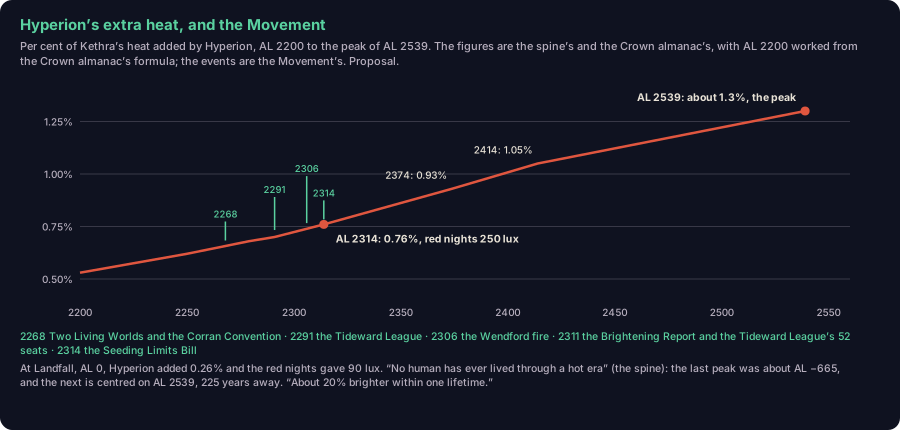
The Movement's argument in one line. The figures are the spine's and the Crown almanac's, with the AL 2200 point worked from the Crown almanac's formula; the Movement's whole history sits on the last stretch of it.
Formal name:The Living Worlds Movement, as its Convention's charter of 2273 names it.
Short name:the Movement. Its members are Worlders; a local group is a Wild Watch; its scientists are the Fellows; its party in the Crown is the Tideward League. Its voters are Tideward League voters: "the Tidewards" is always the district below the Stair. The Cantorate's allied wing has its own noun: a Steward (Chapter V).
Where the name comes from. From a pamphlet, Two Living Worlds (2268), by Dilys Uche, a Hollin naturalist: "There are two living worlds on this planet, the one the Founders brought and the one they found, and the Seeding is the first eating the second." The Corran Convention that met on the pamphlet's strength took its title from it.
Name check (naming principles). The name comes from the pamphlet. The flag's design (below) comes from the Hedge and the red night: different sources.
What others call it:
Who
Name
Meaning
The Charter Party
"the Limits people"
The Seeding Limits Bill, "the Charter Party's most divisive question" (the Crown almanac)
The Commonweal
"the Tidewards' other party"
The docks vote Commonweal; the floods vote Tideward League
The Guildists
"the Wild lobby"
"Pro-market, pro-charter-company" (the Crown almanac), and against
The Seven
"the Stair's conscience, at our expense"
Five of seven against the Bill, Cordale neutral (the Lesser Crowns almanac)
The Literalist Cantorate
"the Doubters"
They doubt that the Return will be "a time of plenty" (the Introduction)
The Holds
"Stair talk"
In the Holds "the Stair" means the Crown, its banks and its charters (the Southern Holds almanac)
The Continuance Circle
"the Moderates"
"Moderation protects the people causing destruction." (the register)
The Imperium
nothing
There are no parties in the Imperium, where the Movement "has almost no legal presence" (the Vardane almanac)
An insult
"creepers"
From "the Creep", the capital farmers' word for the Wild growing back (the Introduction)
Themselves
"Worlders"
Greeting, between Worlders: "Which world?" Reply: "Both." The capital's everyday greeting is "Good step" (Chapter IV); a Worlder on the Tidewards answers it, "Lower every year."
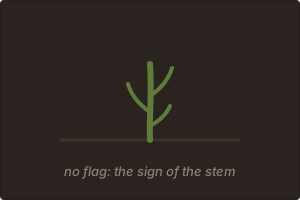
The Hedge-lineThe Continuance Circle: no flag, only the sign of the stem
Symbol
Description
Meaning
Flag: "the Hedge-line"
On Wild-dark, a pale, uneven line, with Hyperion's red disc rising over it
The line is the Hedge, "the boundary between gardenland and Wild" (the Introduction). The disc is the season that is coming. Name check: the name is from the pamphlet; the design is from the Hedge and the red night, and pictures neither of the pamphlet's two worlds.
Emblem
The Hedge line alone, worn as a pale thread on a dark sleeve
Motto
Before the Planet Sets Them
From the Movement's own argument as the Introduction gives it: limits on the Seeding "before the planet sets them instead"
Anthem
None. The Convention sings the Hedge-call, the frontier's cry for help at the Hedge (Chapter V), to a Cantorate tune.
Living Worlds House, in the Tidewards below the Stair, Aletheia: the waterline district, which "floods at every double spring" (Chapter III). The Tideward League's offices are upstairs.
Head
Convenor Perpetua Corrigan, elected by the Convention of 2313 for three years **
Government
The Living Worlds Convention, yearly in Thaw at Corran Mouth: one delegate per Wild Watch, the Tideward League's members of the Hall, and the Fellows' council. It elects the Convenor and writes the Asks.
Members
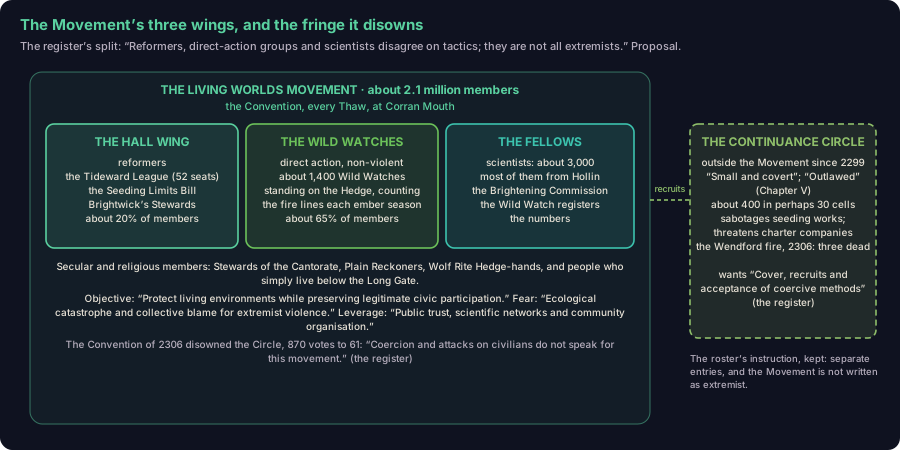
About 2.1 million: 1.6 million in the Crown, 0.3 million in the Seven, 0.2 million on the coast, the Line, the Holds and in orbit
Wild Watches
About 1,400 local Wild Watches; about 60,000 Wild Watch volunteers on the fire lines each ember season
Language
Hallspeech and Landspeech; Southspeech on the frontier
Money
Subscriptions: about Cr 180 million a year
Time
The solar calendar. Its clock is the red-night season, which its founders remembered dimmer.
Standing
Legal in the Crown, the Seven, the coast states and the Line ports; a party in the Crown only. Almost no legal presence in the Imperium (the Vardane almanac), where there are no parties. Few members in the Holds.
The Long Gate across the Thess estuary (the Crown almanac). It closes 22 times in 2250 and about 40 times in 2314.
2250s
Old people say the red nights are brighter than they were. "This is real, not nostalgia" (the spine).
2268
Two Living Worlds, by Dilys Uche. The Corran Convention: 340 delegates at Corran Mouth found the Living Worlds Movement.
2270
The first Wild Watch, on the edge of the Corran Wild, under Zofia Gunnarsson
2273
The Charter of the Convention and the Three Asks: protect the Wild; limit the Seeding; prepare for the hot era
2279–2291
The Corridor War. The Convention declares for neither side. The Wild Watches serve on the fire lines in the charter-country.
2285–2290
The Lean Years (the Southern Holds almanac): famine in the north. The Movement's low point; nobody votes for seeding limits in a famine.
2291
The Tideward League is founded as the Movement's party in the Crown, and named for the district that floods first
2296
The Tideward League's first election: 4 seats
2299
The Continuance Circle breaks away, after the Convention refuses a pledge of direct sabotage by 310 votes to 95
2301
The Brightening Commission sits (the Assembly almanac); the Fellows on it. The Tideward League wins 11 seats.
2304
The Circle's first act: a Seedwright camp at Wendford burned the night before the Charter Court was to license it. The Court grants a continuance. The Circle takes its name.
2306
The Wendford fire: the Circle burns the rebuilt works; three dead. The Crown outlaws the Circle. The Convention disowns it, 870 votes to 61. The Tideward League wins 27 seats.
2311
The Brightening Report (the Assembly almanac). The Tideward League wins 52 seats: "the fastest-growing party" (the Crown almanac).
2313
The Seeding Limits Bill is introduced in the Hall of Voices by the Tideward League's leader, Wystan Mwangi, with Charter Party dissidents
2314
The present. The Bill's second reading in Reaping. The Seven fear the Bill "will be pressed on them next" (the Lesser Crowns almanac). Brightwick elects a First Burgess at the year's end. The Convention of 2314 meets in Thaw at Corran Mouth.
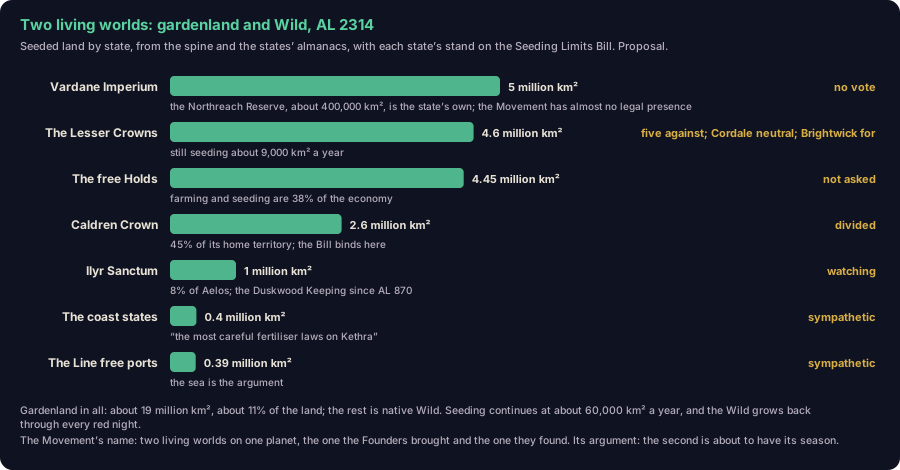
Two living worlds: about 19 million km² of gardenland, and the native Wild that is the rest.
Gardenland
Notes
The planet
about 19 million km², about 11% of the land (the spine)
"Seeding continues at about 60,000 km² a year planet-wide" (the Introduction)
The Crown
about 2.6 million km², 45% of its home territory
"The most intensively seeded country" (the Crown almanac); the Bill binds here
The Seven
about 4.6 million km²
Still seeding about 9,000 km² a year (the Lesser Crowns almanac)
The Imperium
about 5.0 million km²
The Northreach Reserve, about 400,000 km², kept by the state; Hedge-forts on the gardenland edge (the Vardane almanac)
The free Holds
about 4.45 million km²
Farming and seeding are 38% of the economy (the Southern Holds almanac)
Ilyr
about 1.0 million km², 8% of Aelos
The Duskwood Keeping, 410,000 km², "the first protected Wild on Kethra" (AL 870; the Ilyr almanac)
The protected Wilds. The Movement did not make these, and defends every one: the Corran Wild (181,000 km², Highcairn and Corrandale, the largest in the Crown, whose boundary the Bill would make permanent), the Lowfen Reedlands Reserve (22,000 km²), the Ashcombe Steppe Commons (96,000 km²), the Saltreach Flats (4,100 km², a tidehound breeding ground) and the Duskwood Park (38 km², fenced, in Aletheia itself) in the Crown (the Crown almanac); the Whitefell Wild (210,000 km²) in Ormsby and the Inner Meres (18,000 km²) in Sallow (the Lesser Crowns almanac); the Duskwood Keeping (410,000 km²) and the Irrin Slopes (38,000 km²) in Ilyr (the Ilyr almanac); the Northreach Reserve (about 400,000 km²) in the Imperium (the Vardane almanac). About 1.4 million km² in all: less than a tenth of the gardenland, and the Movement's whole map.
The Hedge is "the boundary between gardenland and Wild" (the Introduction): a live front, and on the frontier a burnt and patrolled strip. Hedge work, "clearing, burning and re-seeding the boundary", is a trade (the Introduction). The Movement's Wild Watches do Hedge work too, on the other side of the argument: they clear nothing, and they count.
The Creep is the capital farmers' word for the Wild growing back: "Native plants photosynthesise in Hyperion's deep red light", "the native Wild keeps growing through the night, while Earth fields merely rest", and "As Hyperion brightens, the Wild's advantage grows" (the Introduction). "The Living Worlds Movement calls it the planet reasserting itself."
Earth grasses invade the margins of the Wild, and the Movement "treats this as a harm to the native Wild" (the Introduction). It is the one point on which the Movement and the Charter Party agree that something is spreading where it should not, and disagree about which.
"About 20% brighter within one lifetime" (the spine). "Old people remember dimmer red nights. This is real, not nostalgia."
The seas: "rising about 0.3 m per century now and accelerating" (the spine); about 0.35 m and 0.4 °C since AL 2200 (the Crown almanac). The Long Gate closes about 40 times a year (the Crown almanac). The Tidewards flood at every double spring (Chapter III).
The Movement's reading of it: the retreat inland from the lowest steps, which the capital calls "prudence", is "the first evacuation" (Chapter I).
What no one has: experience. "No human has ever lived through a hot era" (the spine). The last peak was about AL −665; the next is centred on AL 2539, 225 years away.
The Fellows' whole stock: the Brightening Report (2311), the Aumer Deepcore cores (the Ilyr almanac), the Hollin Survey of the Crown's Lands (every ten years; latest AL 2310), the Long Gate's log
People
About 2.1 million members; 60,000 fire-line volunteers
Money
About Cr 180 million a year in subscriptions
Law
The Charter of Rights: "Speech, assembly, a fair trial, belief, privacy, and the right to leave the Crown" (the Crown almanac). The Movement is legal because the Crown is.
The Long Gate went across the Thess estuary in 2204 (the Crown almanac), and every year since it has closed more often. The people who noticed first lived below it, in the Tidewards, where the double springs came up the streets. The people who could say why lived at Hollin, where the sediment cores from Aumer (the Ilyr almanac) said what the Stair already showed: warm eras raise the seas, and one was coming. The Cantorate said the Father's Return would be "a time of plenty" (the Introduction). A wing of it began to say otherwise: the Stewardship school, for whom the Return is "a judgement, not a gift" (Chapter V).
In 2268 Dilys Uche, a Hollin naturalist, published Two Living Worlds, and in Thaw of that year 340 people met in a hired grain hall above Corran Mouth: naturalists, Stewards, Tidewards ward councillors, a few Hedge-hands from the Corran, and the first Fellows. The Corran Convention founded the Movement and has met every Thaw since. Its first act was the Wild Watch at the Corran (2270), under Zofia Gunnarsson: a hut on the Hedge and a register of everything that crossed it, in either direction. Its second was the Charter of the Convention (2273), with the Three Asks: protect the Wild; limit the Seeding; prepare for the hot era. The Asks have not changed.
The Corridor War was fought over phosphate (the Introduction), which is the Seeding's debt, and the Convention declared for neither side; its Wild Watches served on the fire lines in the charter-country, where the war and the ember season met. Then came the Lean Years (2285–2290), the famine that "made the frontier briefly rich" (the Southern Holds almanac) and the capital hungry. Nobody votes for seeding limits in a famine, and the Movement learned it: its membership fell by half, and the Convention of 2288 sat with 90 delegates.
The Armistice let the Movement do what the war had not: stand for election. The Tideward League was founded in 2291 by Amadou Marrable, a Tidewards ward councillor, as the Movement's party in the Crown, and named for the district where the floods are felt first. Four seats in 2296; eleven in 2301, the year the Assembly's Science Council sat the Brightening Commission (the Assembly almanac) with three of the Movement's Fellows on it; twenty-seven in 2306.
The same years gave the Movement the fire it would be blamed for. In 2299 a faction of the Wild Watches asked the Convention to pledge itself to "direct defence of the Wild", which meant sabotage, and lost, 310 votes to 95. The losers left, and in 2304 burned a Seedwright camp at Wendford the night before the Charter Court was to license its conversion. The Court, whose docket runs two years behind (the Crown almanac), granted a continuance, its word for an adjournment, and the burners took the word for a name: the Continuance Circle. In 2306 they burned the rebuilt works, and three people died: two works-hands, Leopold Greenhalgh and Joaquin Sørlie, and one of the Circle's own, Jorunn Salazar. The Crown outlawed the Circle. The Convention of 2306 disowned it, 870 votes to 61, in the words the register gives the Movement: "Coercion and attacks on civilians do not speak for this movement." The Circle's answer is the register's too: "Moderation protects the people causing destruction."
The Brightening Report (2311) put "Hyperion's heat, in numbers the whole planet must now argue about" (the Assembly almanac), and the Crown argued: the Tideward League won 52 seats that year, "the fastest-growing party" (the Crown almanac). In 2313 its leader, Wystan Mwangi, moved the Seeding Limits Bill with a group of Charter Party dissidents from the Corran Reaches: the Corran Wild's boundary made permanent, and net new seeding in the Crown capped. It is "the Living Worlds Movement's central demand and the Charter Party's most divisive question" (the Crown almanac). Its second reading falls in Reaping 2314, and nobody knows the numbers (Part 2).
Convenors of the Living Worlds Convention (complete)#
13 Convenors since the Corran Convention of 2268. The Convention elects the Convenor for three years, once re-electable; the founder held the first two terms. ** The current Convenor is in bold.
#
Convenor
Term
Notes
1
Dilys Uche
2268–2274
Author of Two Living Worlds (2268); called the Corran Convention. The first Wild Watch, at the Corran Wild (2270).
2
Wilhelmina Lombardi
2274–2277
3
Yolanda Yardley
2277–2280
The Corridor War (2279–2291): the Wild Watches serve on the fire lines; the Convention declares for neither side.
4
Philippa Ebrahimi
2280–2283
5
Benedikt Thorsen
2283–2286
The Lean Years (2285–2290): the Movement’s low point. Nobody votes for seeding limits in a famine.
6
Eirik Bakhtiari
2286–2289
7
Vidar Whitcombe
2289–2295
The Tideward League founded as the Movement’s party in the Crown (2291).
8
Marisela Fontaine
2295–2301
The Tideward League’s first seats in the Hall of Voices (2296). The Continuance Circle breaks away (2299).
9
Quentin Ostrowski
2301–2304
The Brightening Commission sits (2301–2311); the Movement’s Fellows on it.
10
Nkechi Kowalczyk
2304–2307
The Wendford fire (2306): three dead. The Crown outlaws the Circle; the Convention disowns it by 870 votes to 61.
11
Ottoline Quiroga
2307–2310
12
Cosimo Fairweather
2310–2313
The Brightening Report (2311). The Tideward League wins 52 seats.
13
Perpetua Corrigan
2313–
The Seeding Limits Bill introduced (2313). The current Convenor; presides over the Convention of 2314 at Corran Mouth.
Leaders of the Tideward League in the Hall of Voices (complete)#
3 leaders since the Tideward League's founding in 2291. **
#
Leader
Term
Notes
1
Amadou Marrable
2291–2303
Founder of the Tideward League; a Tidewards ward councillor. Led it into the Hall in 2296 with 4 seats.
2
Percival Amsel
2303–2311
A Hollin scientist, one of the Movement’s Fellows on the Brightening Commission; 27 seats in 2306.
3
Wystan Mwangi
2311–
52 seats in 2311, "the fastest-growing party" (the Crown almanac). Moved the Seeding Limits Bill (2313).
1.6 million: about 0.7% of the Crown's 214.3 million (the Crown almanac)
In the Seven
0.3 million, two-thirds of them in Brightwick and Cordale, where the Stewardship school is strongest (the Lesser Crowns almanac)
Elsewhere
0.2 million: the coast states, the Line ports, the free Holds, and a few thousand in orbit, who have "never seen the Wild except through a window" (the Vesper almanac)
Wild Watches
About 1,400; the largest on the Corran, the smallest a family on the Southern Hedge
Fellows
About 3,000 scientists, most of them Hollin's
Tideward League members
About 400,000, all in the Crown
Tideward League vote, 2311
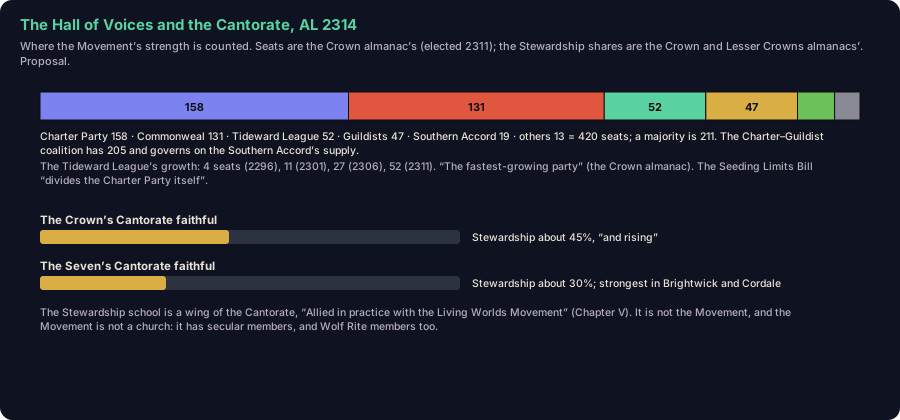
About 12% of the vote: 52 of 420 seats
Where the Movement's strength is counted: the Hall, and the Church.
The Stewardship school is "about 45% of the faithful, and rising" in the Crown (the Crown almanac); most Worlders are Stewards, and most Stewards are not Worlders
No affiliation and Plain Reckoners
33%
The secular wing; strongest among the Fellows
The Wolf Rite
6%
Frontier returnees in the Tidewards, and a few Holds' Hedge-hands. The Rite "does not believe in the Return. It believes in endurance" (Chapter V).
Others
9%
Not the Ashward, who are apocalyptic and "Watched by the authorities" (Chapter V), and whom the Movement keeps at a distance
Hallspeech in the Hall; Landspeech at the Convention; Southspeech at the Wild Watches on the frontier.
The Movement's words:Worlder; Wild Watch (a local group, and its hut); the Asks; Steward (Chapter V's noun, borrowed); the Creep (the farmers' word, used without shame); the first evacuation (Chapter I); "Which world?" "Both."; "Lower every year"; a continuance (the Circle, never named).
The Movement is secular in form and mostly Steward in fact. The Stewardship school teaches that the Return "is a judgement, not a gift" and is "Allied in practice with the Living Worlds Movement" (Chapter V); the Movement's Convention opens with a Steward's reading and a Plain Reckoner's figures, in that order, by a rule of 2273. The Literalist majority of the Cantorate holds that the Return is "a time of plenty" (the Introduction), and the Seeding a duty (the Lesser Crowns almanac). The Wolf Rite "does not believe in the Return" (Chapter V) and expects the world to burn "to its roots, as the emberscrub does, and grow again" (Chapter IV), which is the Movement's argument in another accent. The Ashward expect the end and dig for it (the Southern Holds almanac); the Movement wants nothing to do with them, and is accused of them anyway.
The other side's school: "Soil science, seeding, agronomy" (the Crown almanac); the Seedwrights' guild certifies seeded land (Chapter VI). Wendford is also where the Circle burned.
The Wild Watch register
Every Wild Watch keeps one, on Zofia Gunnarsson's pattern: what crossed the Hedge, which way, and when. The Fellows read them all.