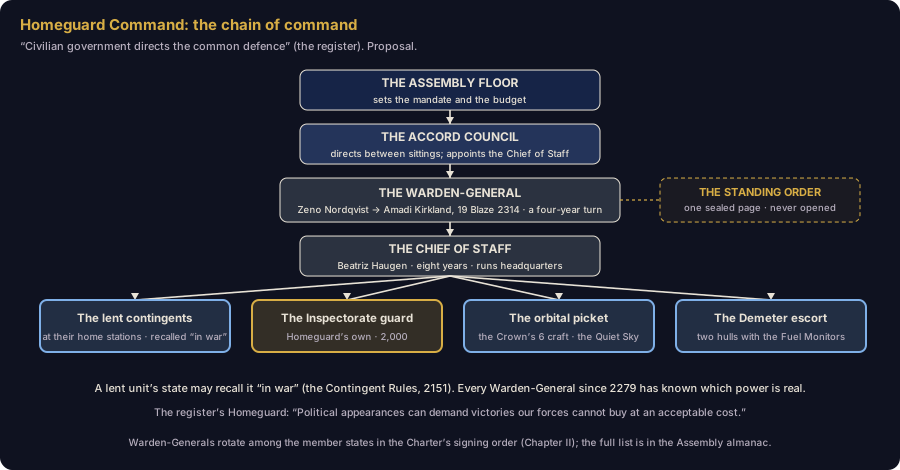
"A joint defence command built from national contingents. Its mandate is planetary defence and enforcing the Accords. Its commander, the Warden-General, rotates among member states every four years." (Chapter II)
The Contingent Rules (2151)
Lent, not owned. Units stay their state's; four-year terms; no orders from a soldier's own state during a turn; recall only "in war"
The Frame Accord (2150) and the Quiet Sky Accord (2150)
The two laws Homeguard enforces with its hands (Chapter II). The Mending Accord's enforcement is Ilyr's and the clinic inspectors'.
The Abernathy Order (2279)
Standing since the Corridor War: when members fight, the contingents go home and the guard escorts the inspectors to both sides
The Standing Order
A single sealed page in the Charter Hall, to be opened by the Warden-General in "a declared planetary emergency". Written in 2150; never opened; its author is not recorded.
Civilian authority, a borrowed commander, and an army on loan.
Level
Who
Notes
The Floor
The fifteen members
Sets the mandate and the budget; "civilian government directs the common defence" (the register)
The Accord Council
Eleven seats
Directs Homeguard between sittings; appoints the Chief of Staff
The Warden-General
Zeno Nordqvist of Stellan, to 19 Blaze 2314; then Amadi Kirkland of the Line ports
Commands for a four-year turn (Chapter II). Has "only what the members lend" (the Assembly almanac).
The Chief of Staff
Beatriz Haugen of the Crown, since 2310
Runs headquarters for eight years; the continuity the turn lacks
The Command Council
The contingent commanders, the Chief Inspector and the picket's commodore
Advises; cannot bind a contingent without its state
The contingents
At their home stations
Called by the Warden-General; released by their states
How it really works. The Warden-General may order any contingent to move. The contingent's state may, "in war", recall it. Every Warden-General since Abernathy has known which of those two powers is real, and every Chief of Staff has planned around it. The register's Homeguard wants "realistic objectives", and its private fear is exact: "political appearances can demand victories our forces cannot buy at an acceptable cost."
The register's line is that "frontline leaders, occupation survivors and headquarters judge acceptable losses differently." In 2314 the three are the Guard's three parties, and the question between them is the Seam.
The frontline
The survivors
Headquarters
Who
The contingent commanders, above all the Assembly Guard's and the Hedge companies'
Hearthport's people in the Demeter escort and the picket: the Watchers' children
The Chief of Staff and the Staff College
The Seam
Put Homeguard escorts at the Seam, where frames clash every season (chapter 11), under the Frame Accord's authority
"You watched once." Go to Hearthport first, or admit that the Guard defends nothing beyond the Precinct.
Homeguard has no post in the belt, no relay of its own, and a Reserve that has not been delivered; an escort at the Seam is a flag with nothing behind it
The Bill
For
For, with a mandate over people at Hearthport written in
For, and drafted it
Acceptable losses
The Convoy Thirty-One were acceptable; the Seam's would be
None of Hearthport's were, and Homeguard accepted them by watching
Any loss the Assembly did not vote for is unacceptable, because the Assembly will disown it
The register's fear
"Orders that … abandon civilians"
"Orders that sacrifice troops for appearances"
Kirkland's first decision, on taking the turn, will be whether to send two hulls and a frame company to the Seam's edge. The Line ports, his own state, oppose the Bill and want no Assembly squadron anywhere near a harbour of theirs; the Seam is not a harbour.
Homeguard commands; the member disciplines. A lent soldier is tried under their own state's military law, at their own state's court, for anything done on Homeguard service. Homeguard's own, the guard and the staff, are tried under the Accord Tribunals' rules by a Warden's Court of three contingent officers.
Accord crimes by Homeguard personnel go to the Accord Tribunals like anyone else's: black sockets three times, twice in the picket and once, in 2262, in a Corridor Regiment officer seconded to headquarters; nothing else in 164 years.
No execution, because the Assembly has none; a member may execute its own under its own law after a Homeguard conviction, and the Imperium did, once, in 2262, for that officer.
Publicly: "We defend the people under civilian authority." Privately: "Political appearances can demand victories our forces cannot buy at an acceptable cost."
Homeguard wants "realistic objectives and care for civilians and troops". The Assembly wants "defence with accountability", and fears "emergency powers becoming permanent military government". What would mend it: "a costly military assessment is heard before orders are issued". What would break it: "a preventable disaster concealed to protect a political figure".
Frontline demand and industrial capacity (the register)
Publicly: "We rely on the yards and the people who keep them working." Privately: "Delivery delays cost lives, but pushing exhausted yards harder can cost more."
Homeguard wants "reliable schedules and honest capacity estimates" for the Reserve; the Coalition almanac's line that Homeguard "wants priority production" is the Assembly's want in the register, which Homeguard carries to the yards. The Coalition wants "worker protection and priorities that stop changing daily". What would mend it: "a joint capacity plan protects both crews and workers". What would break it: "punishment of workers for impossible delivery demands".
"One frame brigade and naval and orbital units" (the Crown almanac), and the Frame School's host. The Royal Frame Corps has 1,650 frames (the Crown almanac); Homeguard borrows 120 of them.
The Crown wants the Requisition Bill, and Homeguard's escorts on its fuel
The Corridor Regiment, today 12,000 and 150 frames, "on call" at Kessard since 2150 and never called. The Imperial Frame Corps has 2,300 frames (the Vardane almanac); on Sentinel Day it parades with Homeguard.
The Order's "separate obligations limit availability"; it wants "specialist deployments, and honest operational limits" (the Ilyr almanac). Its Deepwell detachment, 600 and 12 frames (the Ilyr almanac), is counted under the science charter.
Homeguard wants the Order's frames in an emergency, and knows it will get a letter first
The picket takes Vesper's vectors like everyone (the Vesper almanac); the debris watch is shared; the relays are Vesper's, and the Assembly's request for them in an emergency is refused (the Vesper almanac)
Homeguard wants one relay it does not have to ask for
No mercenary company has served under the Quiet Star since 2152: the Grey Pennon's two years (2150–2152) were the last (the Free Banner Guild almanac). The Guild escorts Vesper's tenders (the Vesper almanac); Homeguard escorts the Monitors aboard them.
Between Arvenne and Hastholm (the Lesser Crowns almanac)
The Inspectorate guard
Homeguard's own
about 2,000
Aletheia
Headquarters
Seconded
about 1,800
Aletheia
The orbital picket
Caldren Crown
about 800; 6 craft
Kethra orbit
The Veiled Sun's Deepwell detachment
Ilyr Sanctum (partner)
600; 12 frames
Hera (the Ilyr almanac)
In all
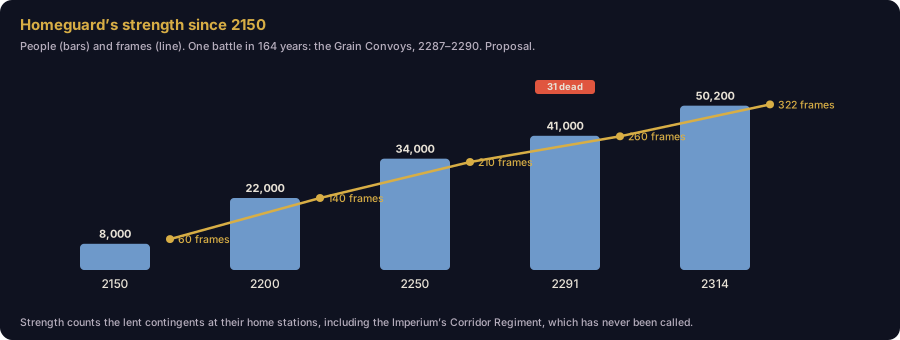
about 50,000; 322 frames; 48 hulls; 6 craft (the Assembly almanac)
The Reserve (2309–2316): 60 frames and 6 hulls, Homeguard's own, from the Coalition's yards: Cr 15 billion. Delivered so far: none.
Doctrine.A hand on every blade; lent, not owned; the Accords first. Homeguard's tasks: enforce the Accords (the guard, the picket); keep the Quiet Sky; escort what the Assembly sends (the Monitors, the Commission, the Grain Flag when asked); and "planetary defence" (Chapter II), which for 164 years has meant nothing anyone has had to define, and which the Standing Order defines in a sealed page.
Homeguard has no economy. It has a budget from the Assembly and fourteen lending states who pay their own.
Cr billion a year
From the Assembly (the Assembly almanac)
14
Contingent allowances paid to the members for lent units
4.0
Escorts and operations (the Monitors, the Commission, the picket's fuel)
2.5
The Reserve Programme (Cr 15 billion over 2309–2316)
2.1
The orbital picket
1.8
The Inspectorate guard
1.5
Headquarters and the Staff College
1.2
The Frame School
0.9
Working. 4.0 + 2.5 + 2.1 + 1.8 + 1.5 + 1.2 + 0.9 = 14.0. The members spend about Cr 21 billion a year more on the units they lend, most of it the Crown's and the Imperium's.
The Command House in the Precinct (Chapter III); the Staff College; the Assembly Guard's frame yard
The Frame School
Thessane, beside the Works (the Crown almanac)
The naval squadron
Corran Mouth, the Crown's largest port by tonnage (the atlas)
The picket
Six craft in low orbit, on Vesper's vectors (the Vesper almanac)
The Demeter escort
Two hulls at Demeter, 34–52 minutes from Kethra by signal (chapter 11)
Relays
None of its own. Vesper carries everything (chapter 11); the Imperium's own relay carries the Corridor Regiment's orders, which Homeguard has never sent.
The Turn: Homeguard's own sheet, published at each Warden-General's handover and otherwise not at all.
Vesper hears everything (chapter 11). Homeguard's orders to the picket and the escort pass through Compact relays, and the Assembly's request for the relays in an emergency has been refused since 2150 (the Vesper almanac).
The Corridor Regiment is reached through the Imperial Legation in Aletheia, by letter.
The Imperium's Day of the Hand (the Vardane almanac): the parade at the Sentinel Field, every pilot's hand raised, Homeguard and the Imperial Frame Corps together
Assembly Day
19 Blaze
The Charter (Chapter V). Every fourth year, the Warden-General's handover: the outgoing turn returns the Quiet Star to the Speaker, who gives it to the next.
Harrow's Day
1 Highsun
The Frame School's passing-out: the year's mixed-nation companies fly together for the first time
Convoy Day
14 Reaping
The Grain Convoys' 31 dead, named at Corran Mouth
Landfall Day and the Unmapping
1 Sowing; 3 Thaw
With the planet (Chapter V). On the Unmapping the picket goes silent with the relays.
The Homeguard mess serves each contingent's food by rota: Crown fish on one day, Orethi gorge bread and Bonded-style wild bread the next (the Vardane almanac), Hedge stew, coast oysters, Line rice, Stair mutton. The Field Ration on Sentinel Day is the Iron Winter's: hard bread, dried dray-meat is refused (the frontier never eats the dray: the Introduction), so salt fish, and black tea.