Chapter III: Domestic Architecture and Urban Planning#
Kethra Almanac • Approved 19 September 2026 • drafted 18 September 2026
Status: approved. Briana approved the whole almanac on 19 September 2026 (the Almanac Approval Decision). Where this file calls something a proposal, read it as approved, except the open points that decision lists.
Status before approval: Everything in this chapter is a proposal built on the spine.
Amended 19 September 2026, with Briana's approval: six cities were added to Other great cities: Brightwick, Corran Mouth, Arvenne, Tessmere, Port Serell and Stellan. The list was drafted on 18 September, before those cities were named, and each has 3.1 million people or more. Their lines are taken from their own almanacs.
Design note. Following the naming principles, Kethran architecture borrows motifs freely, and never from the same source as the name it carries. Aletheia has a Greek name, so its look is not classical Greek. It is terraced stone, blackreed timber and indigo glass, shaped by tides and red nights.
3.1 Habitat Metropolises & Sprawling Settlements#
Aletheia: capital of the Caldren Crown and seat of the Homeworld Assembly#
Setting. The north shore of the Thess estuary, about 60 km upstream from Landfall, at 34° N. The city climbs seven great steps of the Stair. The oldest parts sit highest. The newest and poorest parts sit lowest, closest to the rising water.
Population: 11.2 million in the metropolitan area, 4.3 million in the city proper.
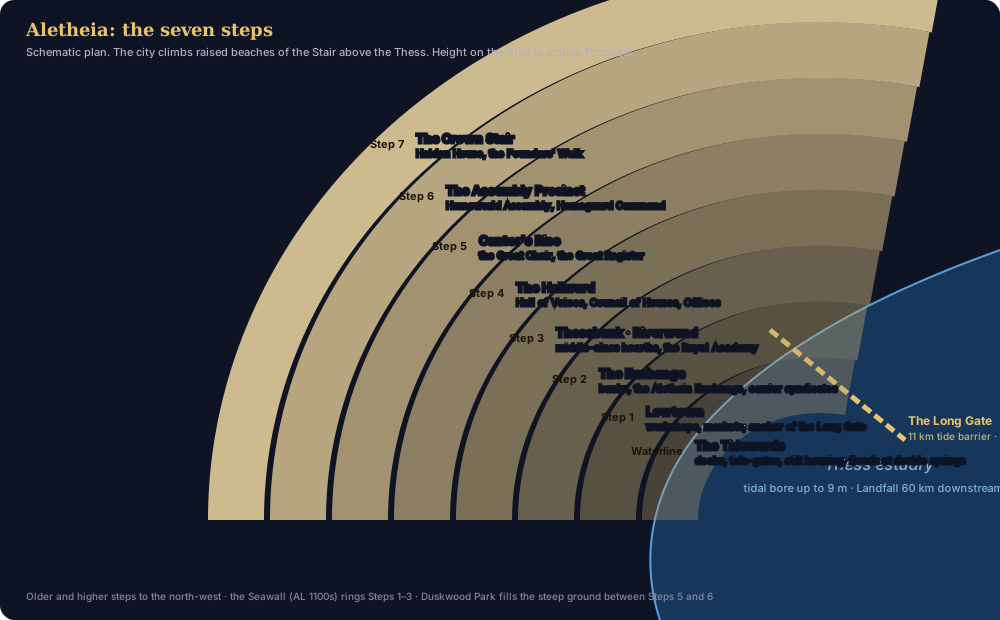
Plan: seven terraces, from the water up
| Terrace | Name | Character |
|---|---|---|
| Waterline (below the Stair) | The Tidewards | Docks, the tide-gates, warehouses and the poorest housing, much of it built on blackreed stilts. It floods at every double spring. Home to Line migrants, dockers and the Unsonged. |
| Step 1 | Lowtown | Workshops, markets, tenements. The Long Gate, the city's tide barrier (see 3.2), is anchored here. |
| Step 2 | The Exchange | The commercial heart: the Aletheia Exchange, the chartered banks and the carrier syndicate houses. |
| Step 3 | Thessbank and Riverwend | Middle-class hearths, schools and the Royal Academy. Thessbank's industrial district runs downriver along this step. |
| Step 4 | The Hallward | Government: the Hall of Voices, the Council of Houses and the Offices of State. |
| Step 5 | Cantor's Rise | The Great Choir, the mother church of the Cantorate, with the song-schools and the Great Register archive. |
| Step 6 | The Assembly Precinct | The Homeworld Assembly: the Floor, the Accord Council, embassies, and Homeguard Command's headquarters. |
| Step 7 | The Crown Stair | The royal palace (Halden House), the oldest Chartered House mansions, and the Founders' Walk: a processional stair carrying stones brought up from Landfall. |
Defences:
- The Seawall, AL 1100s, is the medieval tide-and-siege wall around Steps 1–3. It still stands in part.
- The Long Gate, AL 2204, is the modern tide barrier: 11 km of gates across the estuary. It is closed for double springs and storm surges. In AL 2314 it closes about 40 times a year. In AL 2250 the figure was 22.
- Orbital defence is the responsibility of Homeguard Command and the Crown's Orbital Squadron.
Zones:
- Industry is downriver at Thessbank and on the south shore (Southmere). It keeps its smoke away from the upper steps, since the prevailing wind is westerly.
- Commerce is concentrated at the Exchange on Step 2.
- Wild reserves: the Duskwood Park, a fenced reserve of native forest that the city's Earthkin gardens surround but do not enter, occupies the steep ground between Steps 5 and 6.
Other great cities#
| City | State | Population, metro (millions) | Character |
|---|---|---|---|
| Vardenhold | Vardane Imperium (capital) | 9.8 | A fortress-city on an Oreth river gorge. Concentric walls, marshal quarters and phosphate railheads. Its streets are grids built to be defended. |
| Brightwick | Lesser Crowns: the Free City of Brightwick | 7.9 | A guild republic and an enclave inside Arvenne, in the Arvennish downs: "Bright, crowded, argumentative." The Guildhall seats the Guild Council and the Brightwick Exchange, the Seven's stock market. Its glassworks make indigo glass for half the Crown's windows. |
| Thessane | Caldren Crown | 6.4 | Upper Thess. Iron and frames. The Thessane Works build most of the Crown's frames. |
| Corran Mouth | Caldren Crown | 4.1 | The east-coast port at the mouth of the Corran, the Crown's largest by tonnage, and the seat of Warmreach. The Royal Navy's eastern fleet is based there. |
| Arvenne | Lesser Crowns: Kingdom of Arvenne (capital) | 4.1 | Built in terraces on the upper steps of the Stair. The Stair Accord Secretariat stands above the old town, and the Council of the Lesser Crowns sits there. |
| Tessmere | Free Oreth coast states: Tessmere Republic (capital) | 3.8 | "The walled republic", and the largest city on the coast, on a drowned river mouth. It holds the Senate of Tessmere and the coast's yards, and faces Coastwatch across the Grey March. |
| Port Serell | Lesser Crowns: Principality of Cordale | 3.6 | Cordale's port, where the Principality's money and ships live: shipping insurance and carrier finance. The largest port of the Lesser Crowns, and the base of the Cordale Fleet, the strongest navy of the Seven. |
| Ilyrion | Ilyr Sanctum (capital) | 3.1 | Built into terraced volcanic hillsides on Aelos. The Archive Mount, the sealed repository of the Founders' records, sits at its centre. |
| Stellan | Free Oreth coast states: Stellan Free City (capital) | 3.1 | The coast's great trading harbour, facing the Line and the Imperial port of Hesk. It walled itself and became a Free City in 1471. "Rich, quick, and the least brave of the three, say the other two." |
| Saltline | Line free port | 2.9 | The largest free port, and the Rovessa home harbour. It spreads across three islands and a lagoon full of moored sea-carriers. |
| Eldhaven | Southern Holds (seat of the Compact) | 1.7 | The largest frontier town, on the Eldvang rift. It sits low and wide, built for ember seasons. |
| Pharos Isle | Caldren Crown (Line territory) | 0.6 | The Crown's spaceport, at 0.4° N, the launch site closest to the equator on the Crown's territory. |
| Landfall | Caldren Crown | 0.9 | The founding site. A pilgrimage town, with the Seven Terraces and the Founders' Stones. |
Frontier settlement pattern#
A frontier Hold is a seeded island in the Wild:
- The Hold-house at the centre: the Moot hall, granary and ember shelter.
- Seeded fields around it, in a ring.
- The Hedge beyond the fields: a cleared, burnt and patrolled boundary strip, 200–500 m wide.
- The Wild beyond that.
The standard Hold covers 40–80 km² of gardenland and holds 800–3,000 people. Holds are linked by dray-roads and by the rift railway.
3.2 Public Civil Engineering#
Water#
- Aletheia: three great aqueduct-pipelines bring Corran snowmelt 400 km down to the city, each built in a different era: AL 1300s, AL 1780s and AL 2120s. The oldest still carries water, and it is stone.
- Treatment: mandatory since the Salt Fever of AL 1422–1431. Water boards are among the oldest public bodies in the Crown.
- The Holds: wells, rift springs and cisterns. On the dry plateau, water rights are allocated by the Moot and fought over at the Compact.
- The Line Isles: rain cisterns on every roof, plus desalination in the large ports.
Waste#
- Tidal digesters. Crown coastal cities treat sewage in digesters, where Earth microbes break it down before it goes out on the ebb tide. The tides do the pumping twice a day.
- Night-soil return. Treated human waste is returned to the fields as fertiliser in every Kethran society. This is law, not thrift. Phosphate is scarce (see Chapter VI), and wasting it is a crime in the Crown and a sin in the Cantorate.
Energy grid (the Crown)#
| Source | Share of Crown electricity | Notes |
|---|---|---|
| Fusion | 44% | Seven plants. Fuel is helium-3 and deuterium from Kronos. Since the Taking of Hearthport it has been supplied by the Vardane Imperium under the fuel clauses of the Armistice, and carried down by the Vesper Orbital Compact. |
| Tidal | 18% | The Thess Barrage generating array, integrated with the Long Gate, is the largest tidal plant on Kethra. |
| Thorium fission | 21% | Fuel sands are imported from Aelos under Ilyr licence. |
| Hydroelectric | 9% | Corran Range dams |
| Solar | 6% | Output is poor in the long northern winters |
| Other | 2% |
The grid is national, with interconnectors to the Lesser Crowns. The Holds run on local fission microreactors, solar power and increasingly wind. Blackouts during ember storms are routine.
Transit#
- Crown Railways carry most freight. A high-speed maglev trunk connects Aletheia, Thessane and Hollin at 520 km/h.
- The Thess is navigable for 1,900 km, and barges move grain and iron. The tidal bore must be timed.
- Roads: Reach roads, plus toll highways in the heartland.
- The Rift Railway, AL 1890s, runs 3,200 km through the Eldvang rift and is the frontier's spine.
- Air: passenger aircraft between all major cities. It is 4 hours from Aletheia to Saltline and 9 to Eldhaven.
- Across the Line: Rovessa sea-carriers take most cargo, and passenger flights take most people.
3.3 Architecture Engineering & Construction Materials#
Materials#
| Material | Where from | Use |
|---|---|---|
| Sea-stone | Stair limestone: pale gold, easy to cut, hardening as it weathers | The signature stone of the Crown heartland. Aletheia is a gold-coloured city by day, and a dull bronze one on red nights. |
| Basalt | Oreth and Aelos volcanic rock | Vardane fortress-work; Ilyr's terraced foundations |
| Blackreed | Native reedland timber, rot-proof because Earth fungi can't digest it | Stilts, frames and roofs. Tidewards housing. Prestige interiors. It darkens to near-black with age. |
| Earth timber: oak, pine, cedar plantations | Seeded forests in the Corran foothills | Furniture. It is costly, and rots like wood on Earth. |
| Reefstone lime | Burned reefstone from the Line | Line Isles concrete, which is white and brilliant |
| Alloys and composites | Corran iron, and belt metals via Vesper | Modern towers, the Long Gate, frames |
| Indigo glass | A Crown speciality | Windows tinted to cut red-night glare while passing daylight. The mark of a good house in the capital. |
Designing for Kethra#
| Challenge | Northern solution (the Crown) | Southern solution (the Holds) |
|---|---|---|
| Red nights | Night-shutters on every bedroom. Principal rooms face away from Hyperion's winter rising point. | Shutters, plus ember-screens on windows |
| Cold | Thick stone walls. A heat store in the hearth-room floor. Winter windows angled to catch the low sun. | Blackfrost cellars. Earth-sheltered walls on the plateau. |
| Heat | Moderate: shaded loggias on the upper Stair | Wind-towers that draw cool air through deep cool-cellars. Thick walls with small windows. White reefstone-lime render. |
| Fire | Stone and slate. Fire ordinances since AL 1406. | Ember-proofing: earth roofs, blackreed treated with fire-retardant, a cleared fire-ring of 60 m around every Hold-house, and a buried ember shelter for every family. |
| Water | Buildings raised on the Stair. Flood thresholds, called tide-steps, at every door in the lower city. | Cisterns. Houses sit on rift terraces, above flash floods. |
| Wildlife | Gloamwing screens in the red season | Hedge-walls, and tidehound-proof gates on coastal Holds |
What it looks like#
- Crown style ("Stairwork"). Terraced massing. Gold sea-stone. Deep, dark blackreed eaves. Indigo-glass windows. Stepped roofs that mirror the Stair. It is ornamented with song-bands: carved lines of family or civic verse running around buildings at eye level. On red nights the carved letters fill with shadow and the verses become readable in silhouette.
- Vardane style. Concentric walls, basalt, rank-coloured banners and severe geometry.
- Ilyr style. Houses cut into volcanic terraces. Sealed archive doors. Interior gardens under clear domes. Restrained, precise, almost without ornament.
- Frontier style. Low and wide, half-buried, built of earth and blackreed, with wind-towers. Doors are painted with the family's Gift-line mark.
- Line style. Brilliant white reefstone-lime houses on stilts, with lagoon walkways. It is borrowed from everywhere and belongs to no one.
3.4 Domestic Interior Layouts#
A typical Crown hearth (a Thessbank terrace house, Step 3)#
| Space | Layout and use |
|---|---|
| Tide-step and entry | A raised threshold (tide-step, 40 cm). A boot room with a gloamwing-screen door. |
| Hearth-room | The heart of the house: kitchen, dining and gathering in one room. The song-niche is set in the wall beside the stove. Meals are eaten at one long table. In the red-night season, the family eats redmeal here, late. |
| Parlour | Formal room for guests. Better-off homes have indigo-glass windows. |
| Sleeping rooms | Windowless or fully shuttered. Every bedroom in the Crown must, by building code, be able to be made completely dark. Sleep in darkness is treated as a right. |
| Stores | A pantry for Earthkin food, and a separate Wild-press (see below) |
| Water room | Bath, basin and water closet, connected to the tidal-digester sewers |
| Roof | Earthkin container gardens, and beehives in houses licensed by the Hive Wardens |
The Wild-press. Poorer households, and every frontier household, keep a Wild-press: a leaching trough and press for preparing native roots. It is kept separate from the Earthkin kitchen. Capital households with a Wild-press hide it.
A frontier Hold family house#
- A half-buried main room that serves as hearth, kitchen, workshop and sleeping space in the dark winter.
- A wind-tower and cool-cellar. The family sleeps in the cellar during ember summers.
- An ember shelter: a sealed, buried chamber with air bottles, reached from the cellar.
- The Gift-mother's room, next to the hearth. The mother's line is literally at the centre of the house.
- A dray-byre, sharing a wall with the house for warmth.
Private security#
- The Crown: voice-keyed doors (door-songs) in wealthy homes, and ordinary locks elsewhere. Warden call-boxes on every street. Chartered Houses keep private House guards, licensed and limited in number.
- Vardane: locks and watchmen. Informers are common. Officer families have household troops.
- The Holds: doors unlocked within the Hold and barred against the Wild. Strongrooms hold seed stock and Gift cultures. The most valuable things in a frontier house are the seed-chest and the Gift-jar.
3.5 Micro-Environments & Extreme Adaptations#
| Environment | Habitat | Requirements |
|---|---|---|
| Kethra orbit (the Vesper Orbital Compact) | Spin-rings: rotating habitat rings giving 0.8–1.0 g. There are 38 major habitats, the largest being Vesper Prime, with 1.9 million people. Docks, farms and hydroponic decks. | Pressure integrity. Radiation shielding. Air and water recycling. Everything is maintained by the engineers' guilds, and when maintenance fails, residents die. This is the politics of the Compact. |
| The moons | Mining stations on Pandia, a large regolith base, and Ersa, a dark carbon-rich moon whose small mass makes it cheap to launch from | Low gravity: Pandia about 0.15 g, Ersa about 0.02 g. Sealed domes. Suits outside. |
| The Cinderbelt | Hollowed rocks (asteroids spun for 0.3 g) and yard stations. The Coalition capital is Cinder Hollow; the Imperium's belt headquarters is Castellan Rock; the Lantern League's harbour is the Wick. See Kronos and the Cinderbelt. | Full pressure suits outside. Seven hours of light delay. Radiation storm shelters. Most Cinderborn cannot go downwell (Chapter I). |
| Kronos/Ymir | Hearthport on the moon Hestia (outside the worst radiation) and fuel works on Demeter, both under Vardane occupation. Skimmers dive for fuel. See Kronos and the Cinderbelt. | Intense radiation belts close in. The inner moons are worked by rotating crews. Most people live at Hearthport. |
| Eldvang cool-cellars and ember shelters | Buried rooms under every Hold house | Air bottles for ember storms. Sealed doors. Water stores. |
| Ilyr archive vaults | The Archive Mount: climate-controlled vaults cut into rock, holding Founder data-stores and sealed materials | Restricted access by Key. Some sealed vaults have never been opened since the Silence (what lies inside is open). |
| Line stilt-towns and lagoon habitats | Houses on blackreed stilts over reefstone lagoons | Storm shutters for Girdle storms. Tidehound-proof railings. |
| The Southern Ice mining camps | Heated, sealed camps, worked only in summer | Polar survival gear. The dark winter closes them. |
| Hedge posts | Fortified posts along the gardenland boundary | Antivenom, fire gear, duskdust masks in the red season |
Suits and protective gear#
| Gear | Used for | Notes |
|---|---|---|
| Vac-suit | Belt, orbit and moons | Standard pressure suit. Belt designs are cut long for Cinderborn bodies. |
| Ember cloak | Frontier fire seasons | A treated, heat-reflective hooded cloak that doubles as a fire shelter in an emergency. The frontier's icon. |
| Duskdust mask | Hedge work and red-night seasons | A filter mask. Wearing one in the capital marks you as a Hedge worker. |
| Tide-waders | Tidal flats | Armoured boots against tidehound bites and venomous finners |
| Frame-harness | Pilots | The socket-link collar and support harness for linked piloting |
Guidance for AI actors#
- Height on the Stair is status. Asking an Aletheian "which step?" means asking their class.
- Night-shutters are universal. Waking someone by opening their shutters in the red-night season is a real offence.
- On the frontier, the seed-chest and the Gift-jar are sacred property. Theft of either is treated like murder.
- Orbit and the belt run on maintenance. In any scene there, a leak, a failing scrubber or unpaid dues are live stakes.
Prepared by Claude.