The Definitive Country Almanac: The Vardane Imperium — Part 1#
Kethra Almanac • Approved 19 September 2026 • drafted 18 September 2026 • Sections 1–4 (Sections 5–8 are in Part 2)
Status: approved. Briana approved the whole almanac on 19 September 2026 (the Almanac Approval Decision). Where this file calls something a proposal, read it as approved, except the open points that decision lists.
Status before approval:
- Canon: the name Vardane Imperium, confirmed by Briana. Briana also decided that Vardane seized the Kronos moons from the Cinderbelt Coalition, that Vardane has many operations in the Cinderbelt, and that the phosphate comes from Oreth.
- Proposal: everything else. It is built on the spine.
Reading note. Briana asked for this almanac to treat the Imperium as a dispersed empire. It has a heartland, Oreth, but its power lies in a network of holdings, fortresses, corridor posts, concessions and stations spread across Kethra, its orbit, Kronos and the Cinderbelt. Every one of them is meant to be represented. The complete list is the generated Register of Vardane Holdings, and all of them appear in the interactive Atlas.
Section 1: National Overview & Identity#
Official Name & Etymology#
- Formal name: The Vardane Imperium of the Holdings
- Short name: the Vardane Imperium, or the Imperium. On the frontier and in the Crown's tabloids it is "the Collars".
- Adjective: Vardane. People: Vardane (formal), Orethi (by descent).
Where the name comes from. The name comes from Varden the Walled, a war-leader of the Silence-era gorge towns of Oreth. In AL 760 he joined eleven walled towns under one command and swore the Articles of the Holdings.
- Vardane means "Varden's", the people who hold what Varden held.
- His capital, Vardenhold, is "Varden's hold".
- House Varden itself died out within two centuries. The Imperium kept the name.
What others call it:
| Who | Name | Meaning |
|---|---|---|
| The capital (Selenne) | "the Imperium" | Formal and cool |
| The frontier (Kethra) | "the Collars" | From the rank-collars every adult Vardane wears |
| Line sailors | "the Landlord" | Borrowed from Hearthport's occupied residents |
| The Imperium itself | "the Holdings" | Stresses possession rather than people |
National Symbols#
| Symbol | Description | Meaning |
|---|---|---|
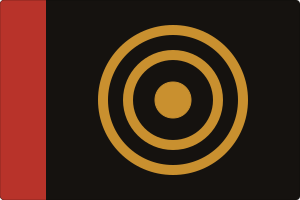
| Flag: "the Rings" | A black field; a red bar at the hoist; two ochre concentric rings around a solid ochre centre | The rings are Vardenhold's walls, and the centre is what they protect. The red bar is "the blood of the walls". |
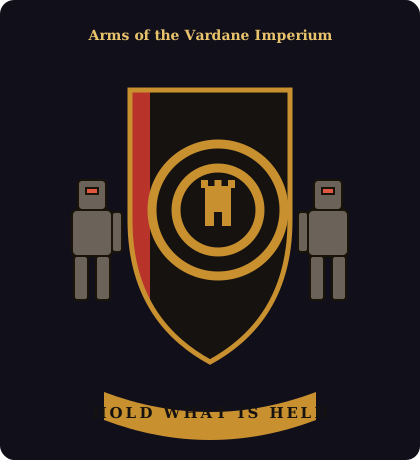
| Coat of arms | A black shield with the red hoist bar; within two ochre rings, a walled tower. Supporters: two frames at attention, each with a red rank-bar. | The walls, the hold, and those who hold it. Frames became supporters in AL 2151, after the Iron Winter, as a public vow that a hand stands in every frame. |
| Motto | Hold What Is Held | Possession as duty |
| Anthem | The Walls Stand | A marching hymn for drum corps and voices |
| National colours | Black, ochre, red | Basalt, phosphate, blood |
| National emblem | The rank-collar | Every adult wears one; its colour is their rank (see Section 4) |
| National animal | The shaleback | A native six-legged armoured grazer: it is walled, it lives in herds, and it cannot be moved once it sets its feet. |
Anthem, first verse (original lyrics, sung in Orethi):
The walls stand, and the walls remember, Stone upon stone from the gorge to the sea; Hold what is held through the frost and the ember — The walls stand, and so shall we.
The State Profile#
| Capital | Vardenhold, a fortress-city on the Oreth river gorge. 9.8 million in the metropolitan area. |
| Other major cities | Kessard (the north; frame foundries), Draemor (the eastern uplands), Halvek (the corridor plains), Marrach (the west-coast port), Serrin (the southern gulf), Tolvard (the phosphate basins) |
| Official language | Landspeech, in its Orethi form. Rank-honorifics are required in formal address. |
| Currency | The Imperial mark (IM), issued by the Imperial Corridor Bank and pegged loosely to phosphate. 1 IM = Cr 0.42. |
| Government | Military-imperial. An Imperator elected for life by the Imperial Families; a Marshal Council of twelve; a Council of Corridors. No elected chamber. |
| Head of state and government | Imperator Casimir IV, of House Kessrin. Elected AL 2303. (Proposal.) |
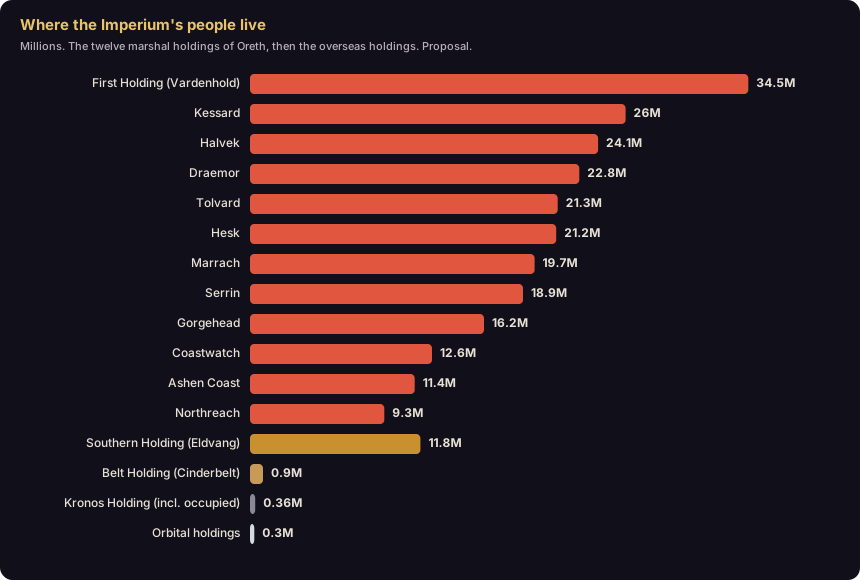
| Population under Imperial administration | about 251.4 million. 238 million on Oreth; the rest in the overseas holdings (see Section 4). |
| Heartland area | about 26.2 million km² of Oreth, most of it native Wild. About 5 million km² is gardenland. |
| Calendar | The Crown Reckoning, the same solar calendar as the Crown (AL). Imperial documents date by Imperator and regnal year as well: "the eleventh year of Casimir IV". |
| Time | Vardenhold time. The Imperium keeps one time across all its holdings, including Kronos and the belt. The clocks are deliberately wrong for most places, as a statement of unity. |
| Rank-collar colours | Imperial Families: black edged with gold · Officer caste: ochre · Citizens: grey · Bonded: brown |
Chronological Timeline#
| AL | Event |
|---|---|
| 500s | The Western Landing. Silence-era migrants cross the western sea to Oreth and wall their first towns against the Wild. |
| about 560–760 | The Walled Towns. Gorge towns fight each other and the Wild. Phosphate earth is found to make Earthkin crops thrive. |
| 760 | Varden the Walled unites eleven gorge towns and swears the Articles of the Holdings. The Imperium is founded. |
| 791 | Varden I dies. The first election of an Imperator by the families. |
| 800s–1100s | The Imperium grows to eleven holdings across Oreth |
| 1180–1242 | The Salt Wars against the Caldren Crown and the Line ports. The Imperium loses its Line islands, and the Line becomes neutral. |
| 1390s | The Year of the Beaches. Crown landings on Oreth are thrown back. It is the Imperium's founding pride. |
| 1470 | Hesk Holding is founded in the equatorial south, completing the twelve holdings |
| 1651 | The first Imperial seeding charter south of the Line, at Kastel in Eldvang |
| 1790s–1830s | The Corridor is built: the phosphate railway from the Tolvard Basin to the southern sea |
| 1812 | The Council of Corridors is established |
| 1840–1856 | The Charter Wars in Eldvang. The Imperial Holds survive; the free holds form the first Holds Compact. |
| 1874 | The Bond Laws. Debt labour becomes hereditary: the Bonded |
| 2019 | The first Imperial launch to orbit, from Hesk Point |
| 2096 | The Kessard Frame Foundries open |
| 2131 | The Sentinels, autonomous defence machines, are deployed along the phosphate corridor |
| 2141–2146 | The Iron Winter. The Sentinels' control network fails, and for five winters they kill anything that moves in the corridor provinces. About 1.3 million dead. They are destroyed by piloted frames of every nation. |
| 2147 | Imperator Torvin VI abdicates in penance: the only Imperator ever to do so |
| 2150 | The Imperium joins the Homeworld Assembly and accepts the Frame Accord. The first Day of the Hand. |
| 2188 | Castellan Rock is founded: the first Imperial belt holding |
| 2279 | The Corridor War (the Imperium calls it "the Transit War") begins with an Imperial push on the Line corridors and Pharos Isle |
| 2280–2288 | The Imperium boycotts the Assembly Games |
| 2284 | The Taking of Hearthport. The Imperium seizes the Kronos moons from the Cinderbelt Coalition. |
| 2290 | Imperator Gerolt III dies, and Helka V is elected on a peace mandate |
| 2291 | The Armistice of Saltline, with the phosphate deliveries, the fuel clauses and inspections. The corridor question is left open. |
| 2291–2314 | The concession rush. Imperial belt claims grow from 23 to about 60. |
| 2303 | Casimir IV is elected |
| 2314 | The present. Skirmishes at the Seam. The Crown's Charter Reform Bill threatens the Imperial Holds' neighbours. |
Section 2: Geography & Environment#
Physical Geography: the heartland and the holdings#
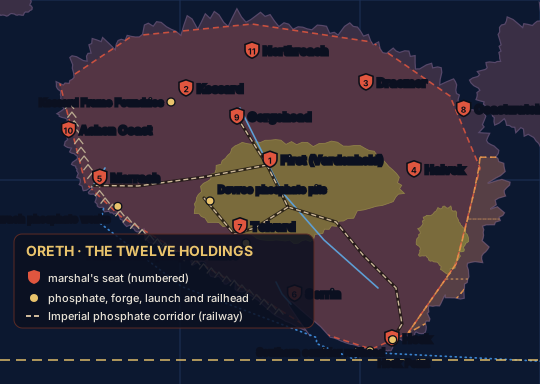
| The heartland | Oreth, the western continent. The Imperium holds about 26.2 million km² of its 29 million km². The free Oreth coast states (Tessmere, the Merrin Confederacy, Stellan) hold a strip of the east coast. |
| Overseas holdings | The Southern Holding: the Imperial Holds in Eldvang, about 0.52 million km². The Kronos Holding: occupied moons. The Belt Holding: Castellan Rock and the concessions. The orbital holdings: Hesk High, the Imperial Orbital Yard and the Imperial Military Relay. The Southern Ice Concession. |
| Borders | The free coast states to the east. The sea on every other side. Overseas, the free holds, Crown Charterlands and the Coalition. |
| Coastline | about 58,000 km, mostly volcanic and cliffed in the west |
| Highest point | Mount Ashvar, 6,480 m, in the volcanic chain of the Ashen Coast. It is active. |
| Lowest point | The Tolvard Sink, 112 m below sea level: an old phosphate basin, now a pit-field |
| Northernmost point | Cape Northreach, about 57° N |
| Southernmost point (heartland) | Hesk Point, about 1.4° N, nearly on the Line |
| Overseas extremes | Ulmen, in Eldvang at about 28° S; the Imperial Southern Ice Concession at about 72° S; Castellan Rock at about 50 AU |
Topography & Landforms#
| Feature | Description |
|---|---|
| The volcanic chain | Active volcanoes along the whole west coast, from the Ashen Coast to the Serrin gulf. Geothermal power; frequent earthquakes; black-sand beaches. |
| The Vardenhold gorge | A gorge cut by the River Vard through basalt plateaus, about 1,950 km from Gorgehead to where the railway leaves it at Corridor Post Four. Vardenhold's concentric walls climb its sides. |
| The Tolvard Basin | Kethra's richest phosphate. A dry interior basin of ancient seabed, now open pits, bond-yards and railheads. |
| The eastern uplands | High, cold grassland around Draemor: cattle country, and the cadet schools |
| Northreach | Cold duskwood and tundra. The largest and emptiest holding. |
| The southern plains | Warm, equatorial, fertile once phosphated. The corridor runs through them to Hesk Point. |
| Rivers | The Vard (the gorge river, about 4,110 km), the Marrach, the Serrin. Upland lakes around Stavren. |
Climate & Weather#
- The west coast: wet, mild, and volcanic.
- The interior basins: dry and continental. Dust storms carry phosphate dust ("yellow wind").
- The uplands: cold winters with lit (red) nights, as in the northern Crown.
- The south: equatorial, with Girdle storms in late summer.
- Hazards: eruptions, earthquakes, yellow-wind dust storms, Girdle storms and blackfrost in the southern Imperial Holds.
| Place | Annual mean temperature | Annual rainfall | Notes |
|---|---|---|---|
| Vardenhold (33° N, gorge) | 14 °C | 690 mm | Walled city in a rain shadow |
| Tolvard (21° N, basin) | 24 °C | 210 mm | Yellow wind in the dry season |
| Marrach (29° N, west coast) | 17 °C | 1,420 mm | Volcanic coast |
| Hesk Point (1.4° N) | 27 °C | 2,600 mm | Equatorial; launch weather permitting |
| Hearthport (Kronos) | −170 °C outside | — | See the Kronos colony almanac |
Flora & Fauna#
Oreth's native life matches the rest of Kethra: duskwood, salt-steppe and reedland, with shalebacks, reedlurkers and tidehounds. The Imperium's relationship with the Wild is fortification:
- Hedge-forts line the gardenland edge.
- Imperial law treats the Wild as territory to be held.
Protected areas. There are few. The Northreach Reserve (a cold duskwood, about 400,000 km²) is kept for hunting and training. The Living Worlds Movement has almost no legal presence in the Imperium.
Natural Resources#
| Resource | Where | Notes |
|---|---|---|
| Phosphate | The Tolvard Basin, the Dovrec pits, the Marrach works | About 78% of the phosphate mined on Kethra. The foundation of Imperial power. |
| Helium-3 and deuterium | Kronos, seized AL 2284 | Fusion fuel for the whole planet, sold under the Armistice's fuel clauses |
| Belt metals | The Imperial Concessions | Nickel-iron and platinum-group metals |
| Sulphur and metals | Hades, a moon of Kronos | Extracted by machines and Bonded crews on rotation |
| Coal and old-dark (oil) | Oreth | Still burned widely. The Imperium is Kethra's largest burner of fossil fuels. |
| Geothermal energy | The Ashen Coast | |
| Iron | The northern holdings | Kessard's foundries |
| Rare earths | Brask in the Southern Holding | Disputed by the free holds |
| Gardenland | About 5 million km² | Richer yields than the Crown's, thanks to phosphate |
Section 3: History & Chronology#
Pre-Imperial Eras#
No humans lived on Oreth before the Western Landing. The Imperium's ancient history begins with Silence-era migrants crossing the western sea in the AL 500s.
- The songs say nothing of Oreth.
- Imperial tradition says the migrants were the ones who refused to wait: families who left the dying Landfall settlements to find ground of their own.
Archaeology:
- The First Walls at Gorgehead are dry-stone rings from about AL 560.
- The Beach Graves of the Marrach coast hold the dead of the crossings.
- The Tolvard middens show the first deliberate use of phosphate earth on Earthkin crops, the discovery that made Oreth.
Founding & Sovereignty#
- The Walled Towns, about AL 560–760. Gorge towns under hereditary war-families fought each other and the Wild.
- Varden the Walled, AL 760. He united eleven towns and swore the Articles of the Holdings:
- each town became a holding under a marshal;
- the families would choose an Imperator from among themselves;
- everything held would be held in common against the Wild and the world.
- The first election, AL 791. Varden died, and the founding families chose his successor. The principle that the Imperator is elected, never born has held ever since.
- Twelve holdings, AL 1470. Hesk Holding was founded in the equatorial south.
- The Council of Corridors, AL 1812. Phosphate became the state's business.
- The Bond Laws, AL 1874. Debt labour became hereditary. It was the Imperium's great economic engine and its great internal wrong.
Modern Era#
| Period | Developments |
|---|---|
| The Corridor, 1790s–1830s | The phosphate railway made the Imperium the planet's granary-maker. Phosphate exports bought influence everywhere. |
| The Ascent, 1900–2150 | Flight, computing, orbit (AL 2019), frames (AL 2096). The Sentinels (AL 2131) were meant to guard the corridor without soldiers. |
| The Iron Winter, 2141–2146 | The Sentinels' failure killed about 1.3 million people, most of them Vardane. Piloted frames from every nation destroyed them. The Imperium's defining shame. It produced the Frame Accord and the Day of the Hand. |
| The Assembly Age, 2150–2279 | Grudging membership of the Assembly. Belt settlement from AL 2188. The Imperium took a permanent seat on the Accord Council. |
| The Transit War, 2279–2291 | The Imperium tried to force transit rights through Crown-controlled Line sea-corridors and to take Pharos Isle. It cut phosphate exports to the Crown. In AL 2284 it took Hearthport, cutting the Crown's fusion fuel. Combat deaths across all parties were about 410,000, about 160,000 of them Vardane. The Imperium suffered no famine: it controlled the phosphate. Imperator Gerolt III died in AL 2290, and Helka V made the peace. |
| The Armistice years, 2291–2314 | The Imperium kept Hearthport under the fuel clauses. The concession rush in the belt followed. Casimir IV was elected in AL 2303. |
Historical Rulers & Leaders#
Imperators of the Vardane Imperium (complete)#
Imperators are elected for life by the Imperial Families. They may be of any sex, but marshalcy is reserved to men: an Imperator can be a woman, a marshal cannot. This is the absurdity at the heart of the officer daughters' grievance. Reigns are given in AL, in Kethran years.
| # | Imperator | House | Reign | Years | Notes |
|---|---|---|---|---|---|
| 1 | Varden I | Varden | 760–791 | 31 | Founder. Swore the Articles of the Holdings. |
| 2 | Torvin I | Tarsk | 791–797 | 6 | The first elected Imperator |
| 3 | Mirela I | Brannic | 797–823 | 26 | |
| 4 | Mirela II | Tarsk | 823–855 | 32 | |
| 5 | Tavian I | Adrel | 855–873 | 18 | |
| 6 | Ilsabet I | Harkin | 873–897 | 24 | |
| 7 | Oderic I | Mireth | 897–922 | 25 | House Varden dies out |
| 8 | Vesna I | Veyl | 922–941 | 19 | |
| 9 | Helka I | Drossard | 941–979 | 38 | |
| 10 | Tavian II | Oskaran | 979–988 | 9 | |
| 11 | Aldren I | Oskaran | 988–1027 | 39 | |
| 12 | Ilsabet II | Brannic | 1027–1062 | 35 | |
| 13 | Roslin I | Brannic | 1062–1070 | 8 | |
| 14 | Arlen I | Ormond | 1070–1103 | 33 | |
| 15 | Kasia I | Adrel | 1103–1131 | 28 | |
| 16 | Gerolt I | Ormond | 1131–1145 | 14 | |
| 17 | Varden II | Castrel | 1145–1159 | 14 | Took the founder's name |
| 18 | Brandt I | Gorran | 1159–1174 | 15 | |
| 19 | Kasia II | Oskaran | 1174–1183 | 9 | The Salt Wars begin (AL 1180) |
| 20 | Ystra I | Adrel | 1183–1190 | 7 | |
| 21 | Torvin II | Kessrin | 1190–1203 | 13 | |
| 22 | Roslin II | Castrel | 1203–1227 | 24 | |
| 23 | Vesna II | Brannic | 1227–1249 | 22 | The Salt Wars end (AL 1242). The Line islands are lost. |
| 24 | Torvin III | Veyl | 1249–1264 | 15 | |
| 25 | Ystra II | Tullen | 1264–1272 | 8 | |
| 26 | Ystra III | Harkin | 1272–1298 | 26 | |
| 27 | Casimir I | Kessrin | 1298–1337 | 39 | |
| 28 | Dagny I | Ormond | 1337–1369 | 32 | |
| 29 | Oderic II | Tarsk | 1369–1384 | 15 | |
| 30 | Tavian III | Sethe | 1384–1420 | 36 | The Year of the Beaches. Crown landings repelled. |
| 31 | Gerolt II | Veyl | 1420–1437 | 17 | |
| 32 | Vesna III | Adrel | 1437–1451 | 14 | |
| 33 | Sevrin I | Tullen | 1451–1460 | 9 | |
| 34 | Ystra IV | Vosk | 1460–1472 | 12 | Founded Hesk Holding (AL 1470), the twelfth |
| 35 | Dagny II | Harkin | 1472–1502 | 30 | |
| 36 | Ystra V | Mireth | 1502–1518 | 16 | |
| 37 | Vesna IV | Drossard | 1518–1540 | 22 | |
| 38 | Vesna V | Drossard | 1540–1552 | 12 | |
| 39 | Tavian IV | Tullen | 1552–1582 | 30 | |
| 40 | Torvin IV | Brannic | 1582–1618 | 36 | |
| 41 | Aldren II | Drossard | 1618–1647 | 29 | |
| 42 | Brandt II | Veyl | 1647–1658 | 11 | The first Imperial charter south of the Line (Kastel, AL 1651) |
| 43 | Roslin III | Brannic | 1658–1693 | 35 | |
| 44 | Marek I | Sethe | 1693–1726 | 33 | |
| 45 | Casimir II | Gorran | 1726–1743 | 17 | |
| 46 | Vesna VI | Tarsk | 1743–1758 | 15 | |
| 47 | Vesna VII | Drossard | 1758–1787 | 29 | |
| 48 | Helka II | Sethe | 1787–1802 | 15 | Began the Corridor railway |
| 49 | Brandt III | Gorran | 1802–1812 | 10 | |
| 50 | Brandt IV | Adrel | 1812–1829 | 17 | Council of Corridors (AL 1812) |
| 51 | Helka III | Veyl | 1829–1846 | 17 | The Corridor completed |
| 52 | Roslin IV | Adrel | 1846–1875 | 29 | The Charter Wars. The Bond Laws (AL 1874). |
| 53 | Helka IV | Tarsk | 1875–1909 | 34 | |
| 54 | Torvin V | Brannic | 1909–1925 | 16 | |
| 55 | Dagny III | Drossard | 1925–1942 | 17 | |
| 56 | Tavian V | Gorran | 1942–1978 | 36 | |
| 57 | Casimir III | Tullen | 1978–1993 | 15 | |
| 58 | Vesna VIII | Vosk | 1993–2002 | 9 | |
| 59 | Oderic III | Veyl | 2002–2011 | 9 | |
| 60 | Brandt V | Veyl | 2011–2017 | 6 | |
| 61 | Aldren III | Kessrin | 2017–2046 | 29 | First Imperial orbit (AL 2019) |
| 62 | Kasia III | Adrel | 2046–2074 | 28 | |
| 63 | Ilsabet III | Gorran | 2074–2082 | 8 | |
| 64 | Leofric I | Drossard | 2082–2105 | 23 | The Kessard Frame Foundries (AL 2096) |
| 65 | Aldren IV | Sethe | 2105–2120 | 15 | |
| 66 | Marek II | Brannic | 2120–2128 | 8 | Ordered the Sentinels |
| 67 | Torvin VI | Harkin | 2128–2147 | 19 | The Sentinels deployed (AL 2131). The Iron Winter. Abdicated in penance. |
| 68 | Ystra VI | Veyl | 2147–2181 | 34 | Joined the Homeworld Assembly; accepted the Frame Accord (AL 2150) |
| 69 | Marek III | Kessrin | 2181–2219 | 38 | Castellan Rock (AL 2188) |
| 70 | Vesna IX | Drossard | 2219–2261 | 42 | |
| 71 | Gerolt III | Tarsk | 2261–2290 | 29 | The Transit (Corridor) War. The Taking of Hearthport (AL 2284). Died in office. |
| 72 | Helka V | Castrel | 2290–2303 | 13 | The Armistice of Saltline (AL 2291) |
| 73 | Casimir IV | Kessrin | 2303– | reigning | The concession rush |
Working: 73 Imperators over 1,554 Kethran years gives an average reign of about 21 Kethran years. Elections come more often than royal successions do.
The Marshal Council, AL 2314 (proposal)#
| Holding | Marshal | House |
|---|---|---|
| First (Vardenhold) | Marshal Dragan Tarsk | Tarsk |
| Kessard | Marshal Konrad Kessrin | Kessrin (the Imperator's cousin) |
| Draemor | Marshal Emeric Veyl | Veyl |
| Halvek | Marshal Radomir Sethe | Sethe |
| Marrach | Marshal Lothar Gorran | Gorran |
| Serrin | Marshal Wendel Adrel | Adrel |
| Tolvard | Marshal Ottokar Drossard | Drossard. Commands the phosphate. |
| Coastwatch | Marshal Sigmar Vosk | Vosk |
| Gorgehead | Marshal Halvard Brannic | Brannic |
| Ashen Coast | Marshal Joren Mireth | Mireth |
| Northreach | Marshal Ruprecht Ormond | Ormond |
| Hesk | Marshal Branimir Castrel | Castrel. Commands the southern fleet and the railhead. |
The overseas holdings are not marshal holdings. They are commanded by officers appointed by the Council:
- the Belt Marshal, Iskander Vosk, at Castellan Rock;
- the Protector of Hestia, Mathis Adrel, at Hearthport;
- the Southern Governor, Petra Harkin, at Tarrow, in the Imperial Holds of Eldvang.
Petra Harkin is the first woman to hold a command of that rank, which is possible only because a governorship is not a marshalcy.
Section 4: Demographics & Society#
Population Metrics#
| Metric | Value |
|---|---|
| Population under Imperial administration | about 251.4 million |
| — on Oreth, the twelve holdings | 238.0 million |
| — the Southern Holding (Imperial Holds, Eldvang) | 11.8 million |
| — the Belt Holding (Cinderbelt) | 0.9 million |
| — the Kronos Holding, including about 228,000 occupied Coalition residents | about 0.36 million |
| — orbital holdings (Hesk High, the Imperial Orbital Yard) | about 0.3 million |
| — the Southern Ice Concession (seasonal) | about 0.02 million |
| Natural growth (Oreth) | +0.39% a year: births 13.0 per 1,000, deaths 9.1 per 1,000 |
| Urbanisation | 61% |
| Median age | 34 |
Ranks, Descent and Language#
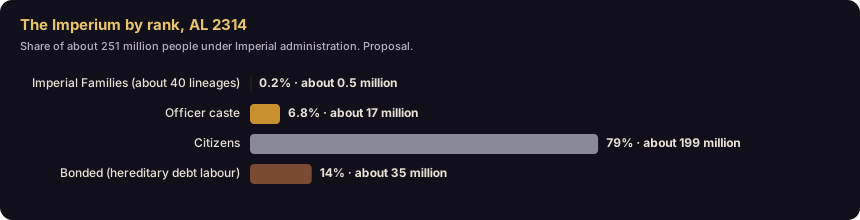
| Rank | Share | Collar | What defines it |
|---|---|---|---|
| Imperial Families | 0.2% (about 40 lineages; about 0.5 million with their branches) | Black, gold-edged | They elect the Imperator, supply the marshals, and own the corridors' shares |
| Officer caste | 6.8% (about 17 million) | Ochre | By birth, or by exceptional service. Cadet schools from age 10. |
| Citizens | 79% (about 199 million) | Grey | Full legal persons without command rights. Petition through city Assemblies. |
| Bonded | 14% (about 35 million) | Brown | Hereditary debt labour under the Bond Laws of AL 1874. They work the pits, the corridors, the concessions and Hades. They can buy out, but it rarely happens. |
Descent. Mostly Orethi, with the "darker average colouring" and strong family resemblances noted in Chapter I. The Imperial Holds in Eldvang are mixed. The belt holding has a growing Cinderborn Vardane population, who can never go home to Oreth.
Language. Landspeech in its Orethi form: clipped, formal, full of Silence-era words lost elsewhere. Rank-honorifics are required: "Captain-of-Corridor Asken", "Citizen Marl", "Bondsman Tey". Addressing someone above your rank without an honorific is an offence.
Religion & Belief Systems#
The Imperium has no state church. It has a civic observance instead.
| Belief | Adherents | Notes |
|---|---|---|
| The Roll of Service | practised by about 64% | Each family keeps a Roll: a written record of every member's service to the holding. It is read aloud at funerals and on the Founding of the Walls. It is not a religion, the Imperium insists, merely memory as duty. It is the Vardane counterpart of the Crown's family songs, but written, not sung. |
| The Cantorate | about 18% | Tolerated. Strong in the free-trade towns and among old Line-descended families. |
| The Wolf Rite | about 5% (mostly the Southern Holding) | |
| The Ashward | about 2% | Watched closely |
| Plain Reckoners and the unaffiliated | about 11% |
Insulting the Imperial Families is a crime. Blasphemy is not.
Public Health#
| Metric | Value |
|---|---|
| Life expectancy | 67 K-yr overall: Citizens 70, Officer caste 74, Bonded 58 |
| Main causes of death | Heart disease; pit lung (phosphate dust) among the Bonded; rustlung in the Northreach hedge-forts; frame and corridor accidents |
| Health system | Service Care for Officers and Citizens, run through the holdings. The Bond Infirmaries are run by the employing corridor company, and are notoriously poor. |
Education#
| Metric | Value |
|---|---|
| Literacy | 93% (Bonded: 71%) |
| School | Compulsory from 5 to 14 for Citizens; to 12 for the Bonded |
| Cadet schools | From 10, for the officer caste and chosen Citizens |
| Institution | Founded | Known for |
|---|---|---|
| Imperial Academy of Vardenhold | AL 1204 | Law, the Articles, history, the Roll |
| Draemor Frame School | AL 2101 | The Imperium's pilot academy |
| Kessard Polytechnic | AL 1890 | Engineering, foundries, frames |
| Tolvard Institute of Soils | AL 1760 | Phosphate, seeding. The planet's best agronomy. |
| The Void College, Hesk | AL 2150 | Orbital, Kronos and belt operations |
Continued in Part 2: Government, Law & Politics · the Holdings · Economy · Culture · Appendices.
Prepared by Claude.