The Definitive Country Almanac: The Vesper Orbital Compact — Part 2#
Kethra Almanac • Approved 19 September 2026 • drafted 18 September 2026 • Sections 5–8 (Sections 1–4 are in Part 1)
Status: approved. Briana approved the whole almanac on 19 September 2026 (the Almanac Approval Decision). Where this file calls something a proposal, read it as approved, except the open points that decision lists.
Status before approval: proposal throughout, except what Part 1 lists as established in earlier files.
Section 5: Government, Law & Politics#
Constitutional Framework#
| Instrument | What it does |
|---|---|
| The Compact (2068) | The four Articles (below). Amended only by the Board, two-thirds of both benches together. |
| The Airlock Law (2071) | "The Compact does not kill with the sky." No airlock is ever a punishment (Chapter II). |
| The Guild Charters (2077–2131) | Charter the six maintenance guilds and give them the Red Board: the power to declare a habitat unsafe, which nothing overrides |
| The Standing Act (2164) | Compact standing for the roster-born |
| The Quarantine Rules (2236) | The Red Ring, the 40-day hold, and the red board that closes a dock |
| The Beacon Settlement (2251) | Made with the Outer Lantern League (Part 1). Neither side has kept it since 2270. |
| The Rings Truce (2280) | A treaty, not a law: no fighting inside the Compact's traffic zone. Signed by the Crown and the Imperium; kept by everyone. |
| The Dues Order (2310) | No Compact service to anyone in arrears; League strings on the Belt Line only for family and distress |
The four Articles of the Compact#
| # | Article | What it means |
|---|---|---|
| I | One Sky | Every ship in Kethra orbit moves on a vector from the Compact's Traffic Control. The Imperium signed this Article and no other. |
| II | One Fund | Every habitat pays dues into one maintenance fund, and the guilds maintain every habitat from it |
| III | One Roster | Residency in orbit is a place on a habitat's roster, and every place owes its due |
| IV | Open Docks | The docks are open to any ship that pays the fee and takes a vector |
The register's objective, "shared infrastructure and authority over orbital traffic", is Articles I and II. Its fear, "infrastructure failure or settlements refusing common obligations", is what happens when Articles II and III fail. The Compact has never had a different politics.
The Compact Board#
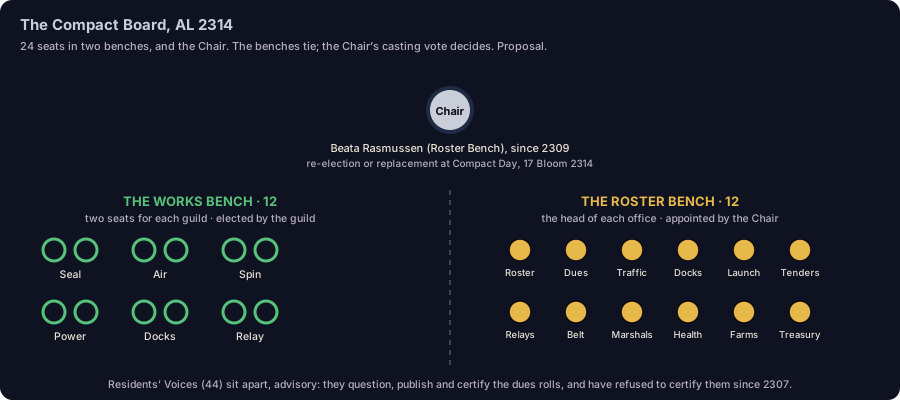
| Seats | Who | How chosen |
|---|---|---|
| 12 | The Works Bench: two for each of the six guilds (Seal, Air, Spin, Power, Docks, Relay) | Elected by each guild's members |
| 12 | The Roster Bench: the heads of the twelve offices (Roster, Dues, Traffic, Docks, Launch, Tenders, Relays, Belt, Marshals, Health, Farms, Treasury) | Appointed by the Chair from the offices' own ranks, and confirmed by the Board |
| 1 | The Compact Chair | Elected by the Board at Compact Day for five years, once re-electable. Votes only to break a tie. |
- Twelve against twelve. The benches are equal by design, so that neither the guilds nor the offices can rule alone. In practice they tie on everything that matters, and the Chair's casting vote is the Compact's government. That is why the election of a Chair is the only election in orbit that anyone watches.
- The Residents' Voices. Every major habitat elects a Voice, and the lesser stations elect six between them: 44 Voices in the Voices' Hall at Vesper Prime. They are advisory (Chapter II): they may question any office, publish anything, and certify the dues rolls. Since the breach of 2307 they have refused to certify them. Chief Voice Zara Mensah leads them.
- The Red Board. Any guild may declare a habitat, a dock or a ship unsafe. Nothing overrides it: not the Chair, not a flag, not a squadron. It has been used against the Board itself twice, most recently in 2308, when the Seal Guild red-boarded three outer rings and forced the repairs the Board had refused to fund.
Engineers and Officials#
Chapter II says the engineers "hold real power" and the officials "administer", and the register gives the split: "Engineers prioritise reliable service; officials equate resistance with political defiance." In orbit they are the Works and the Roster.
| The Works (the guilds) | The Roster (the offices) | |
|---|---|---|
| The register's line | "Engineers prioritise reliable service" | "Officials equate resistance with political defiance" |
| Who | The six guilds and their apprentices; most of Ring Seven; the Polytechnic | The twelve offices; the Marshals; most of the Crown-flagged rings; the Treasury |
| Want | Repairs first; an independent audit; a dues holiday for the outer rings; the Voices given a binding vote on the dues rate | Dues first; the Arrears acknowledged before any audit; the Marshals sent to the lamplit households; the League made to name a negotiator |
| Say of the other | "The Roster would let a ring fail to prove a point about dues." | "The Works would spend the fund on people who don't pay into it." |
| Remember | Ring Thirty-One (2307): "thirty years of deferred maintenance" | The First Dark (2247) and the Withholding (2268): the "settlements refusing common obligations" that the register names as the Compact's fear |
| Seats in 2314 | 12 | 12, and the Chair |
The Election of 2314 and the Audit Question#
- The election. At Compact Day, 17 Bloom 2314, the Board elects a Chair. Beata Rasmussen (the Roster) seeks the one re-election the Compact allows. Nnamdi Kovac, the Master of Works, stands against her. Twelve seats each; the sitting Chair may not vote for herself; the tie is broken by lot, which has happened once, in 2179, and is the reason the Compact has a Lottery Room.
- The audit. The register names the way out of the Lantern quarrel: "independent maintenance audits followed by repairs and restored payments." Kovac would have the Assembly's Fuel Monitors, or Ilyr, audit the Lanterns and the outer rings together, and pay for the repairs from the light-fee and the dock fees. Rasmussen would audit nothing until the League acknowledges the Arrears, because "an audit of a debt not admitted is a gift".
- The Voices' price. Mensah has told both candidates that the Voices will certify no dues roll until the outer rings' backlog is funded. Neither has agreed.
- What Vesper wants from the League, in the register's words: "compliance and a negotiator who can bind the League". Whether the League's Lampfall vote produces one is not in the Compact's hands (the League almanac).
The Roster#
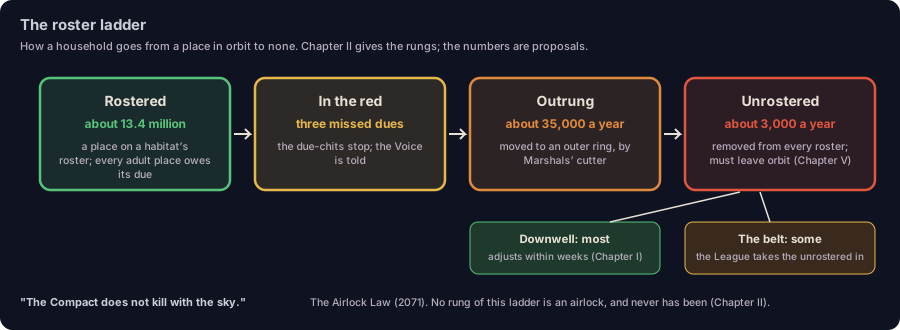
| Rung | What it is |
|---|---|
| Rostered | A place on a habitat's roster: the right to breathe its air. Every adult place owes the due, about Cr 4,400 a year; a child's place half that. |
| In the red | Three missed dues. The Roster Office writes to the habitat's Voice, and the household's due-chits stop. |
| Outrung | Moved to an outer ring, "the least maintained habitats" (Chapter II). About 35,000 people a year. The move is by Marshals' cutter, with what a family can carry. |
| Unrostered | Three years in default, or a Compact Court sentence. "Removed from every habitat roster", and must leave orbit (Chapter V). About 3,000 people a year: most go downwell, where an Upweller can live (Chapter I); some go to the belt, where the League takes them in (the League almanac). |
Due-chits. The Compact pays its guilds and offices about 40% of their wages in due-chits, which are accepted for dues at face value and for nothing else. Since they are the only thing the Roster Office must accept, and the Compact issues no more than it pays, residents buy them at a premium: Cr 1.15 (Chapter VI). The premium is the price of staying rostered.
The Rings (administrative divisions)#
Every major habitat has a Ring Council of its guild hall, its office and its Voice, and keeps its own roster. Every place below is on the interactive Atlas.
| Division | Places | People | Notes |
|---|---|---|---|
| Vesper Prime | Vesper Prime · the Compact Board · the Roster Office · the Polytechnic · Vesper Docks | about 1.9 million | The seat |
| The inner rings | Ring Seven · Ring Twelve · Ring Fourteen · the Red Ring · Ring Twenty-One and 23 others | about 9.4 million | The working Rings |
| The outer rings | the Outer Rings · Ring Thirty-One and eight others | about 1.6 million | Dues defaulters, and the lamplit households |
| Low orbit | Old Vesper · Traffic Control · the Marshals' station · relay control | a few thousand | The Compact's own low-orbit posts, among the ground powers' stations |
| The fleets | the Launch Office · the fuel tenders | about 40,000 crews | Launch craft and tenders |
| The moons | the Pandia Regolith Base · Ersa Station | about 36,000 | Regolith and carbon |
| The far posts | Belt Line node · Belt Line node (east) · Echo · the tender berth at Hearthport | about 16,000 | The relays and the fuel road (chapter 11) |
Guests and neighbours in orbit, outside the rosters: the Crown's Pharos High; the Imperium's Hesk High, Orbital Yard and Military Relay, "outside Compact rule" (the Vardane almanac); the Homeguard picket; the free port's Saltline Tether Yard; and the Rovessa High Houses' lighter berth at Vesper Docks. All of them take vectors. None of them pays dues. The Free Banner Guild's Tide Pennon berths at the Docks too, not as a guest but as the Compact's own escort contractor (the Free Banner Guild almanac).
The Judiciary#
- The Compact Court, at Vesper Prime: seven Assessors, three named by the guilds, three by the offices and one drawn by lot from the Voices. It hears appeals, killings, and every unrostering.
- Ring courts for everyday cases, under the Ring Council.
- The Habitat Marshals (Chapter II): about 5,000, with 40 cutters. They keep order, execute outringings and unrosterings, and seize ships without vectors.
- Sentences: fines, paid in due-chits; work-duty, maintenance labour under a guild; outringing, loss of residency, "the most feared penalty" (Chapter II); and unrostering, removal from every roster (Chapter V).
- No execution, and no airlock: "Airlocks are never used as punishment" (Chapter II). The Airlock Law of 2071 is read aloud at every Court sitting. To threaten someone with the sky is itself a crime.
- Vector law. A ship that moves without a vector is a hazard, and a hazard is seized. This is the law under which the Marshals took three Lanterns in 2247–2251, and the League has never forgiven it (the League almanac).
Foreign Relations & Defence#
Standing#
- An associate seat at the Homeworld Assembly: it can speak, and vote only on space affairs; "its status is disputed" (Chapter II). The Compact has never asked for a full seat, because a full seat is for states, and the Compact insists it is not one.
- It keeps the Frame Accord and, above all, the Quiet Sky Accord: the relay constellation is aimed inward, and the Homeguard picket watches every transmitter in orbit (the atlas).
Relations#
The Rovessa and League rows follow the relationship register, in both directions.
| Power | Relation | The Compact's view | What each side wants |
|---|---|---|---|
| Rovessa Caravans | Port fees and infrastructure (the register) | Publicly: "Major carriers share responsibility for our infrastructure." Privately: "Caravan traffic funds maintenance; abrupt exemptions would shift costs onto residents." | The Compact wants "predictable payments and maintenance cooperation". The Rovessa want "auditable fees and equal treatment", and complain that "every exception seems easier for politically connected fleets". What would mend it: "a transparent port budget with shared oversight". What would break it: "selective enforcement or a dock closure during a medical emergency". |
| Outer Lantern League | Authority, maintenance and frontier autonomy (the register) | Publicly: "Disputed members must meet common obligations." Privately: "Their captains can disrupt essential traffic while claiming every obligation is tyranny." | The Compact wants "compliance and a negotiator who can bind the League". The League wants "accountable services and an end to coercive seizures". What would mend it: "independent maintenance audits followed by repairs and restored payments". What would break it: "collective punishment or an attack that harms ordinary orbital residents". The League says the Dues Order is the first; the Compact fears a flint attack on a tender is the second. |
| Caldren Crown | Founding sponsor; a close partner (the Crown almanac) | The Crown built Old Vesper and paid for the Compact. It flies three rings and elects three orbital seats. It also depends on the tenders for 44% of its electricity (Chapter III). | The Crown wants "fuel and relay access; stability in orbit" (the Crown almanac). The Compact wants the Crown to remember that it is a partner, not a province. |
| Vardane Imperium | Cold (the Vardane almanac) | It signed Article I and nothing else, "built its own orbital yard and military relay to avoid depending on Vesper", and keeps 300,000 people in orbit outside the rosters. Since 2291 it sells the Crown its fuel through Compact tenders it does not trust. | The Imperium wants "independence in orbit" (the Vardane almanac). The Compact wants the Void Squadron to keep the Rings Truce. |
| Cinderbelt Coalition | Indispensable to it (the Coalition almanac); a customer and a rival | Every freighter unloads at Vesper Docks; every string passes the Belt Line. The Coalition "has asked for its own relay chain for thirty years" (the Coalition almanac). | The Coalition wants its own relays. The Compact has said no thirty times, because the Belt Line is the leverage chapter 11 describes. |
| Line free ports | Partner and rival (the Line almanac) | The Launch Office's craft fly from Saltline; the Tether Yard is "open to all" and takes trade the Docks would like | Fees, and the Launch Office's landing rights |
| Lesser Crowns | Bankers | Cordale's banks, the lenders to Line carriers and belt haulers (the Lesser Crowns almanac), hold most of the Rings' bonds: about Cr 190 billion (proposal) | Interest paid on time, which it always is |
| Ilyr Sanctum | Old partners | The Relay Guild has been half Ilyr since 2119; the habitats' fusion runs under Ilyr licence; Ilyr "buys most of its launches from Vesper" (the Ilyr almanac) | Safe passage for Deepwell and Farlight; the Quiet Sky kept |
| Homeworld Assembly | The associate seat | The Fuel Monitors ride the tenders (chapter 11) | The Assembly wants the relays under its control in an emergency. The Compact has refused since 2150. |
| Homeguard Command | The picket | Enforces the Quiet Sky on orbit's transmitters (the atlas) | |
| Free Banner Guild | Hired escorts | Escorts for the tenders since 2284: on the retainer until the tenders sailed in 2291 (the Free Banner Guild almanac) | |
| Southern Holds | Distant | The frontier sends few people up and calls the Compact "the Rings" | |
| Black Ledger | Rumoured | Every year someone claims the Ledger buys strings from a relay clerk. The Relay Guild has never found one. |
The Arrears, from the Compact's side#
| The Compact's books | The League's books | |
|---|---|---|
| What | Station dues unpaid since the Withholding (2268): Cr 31 million a year for 46 years, with service interest at 2.9% | The League's 70% of the light-fee, kept since the Offset (2270), and the repairs never made |
| Total | About Cr 2.9 billion, owed by the League | About Cr 3.4 billion, owed by the Compact (the League almanac) |
| Scale | The whole light-fee is about Cr 74 million a year: 0.008% of the Compact's output | About 0.4% of the League's output; the Arrears themselves, Cr 3.4 billion by the League's books, are about a sixth of a year of it |
Working. Cr 52 million is 70% of the light-fee, so the fee is about Cr 74 million a year. Cr 74 million ÷ Cr 940 billion = 0.008%. Cr 74 million ÷ Cr 19 billion, the League's output (the League almanac) = 0.4%; Cr 3.4 billion ÷ Cr 19 billion ≈ 18%. The Arrears are a rounding error to the Compact and a sixth of a year's output to the League, which is why the Roster can afford to be stubborn and the League cannot.
Defence#
Defence spending: about Cr 6 billion a year, about 0.6% of output. The Compact has no navy, and its doctrine is that it must never need one.
| Force | Strength | Notes |
|---|---|---|
| Traffic Control | about 3,000 controllers | The Vectors. Nothing moves in orbit without one. |
| The Habitat Marshals | about 5,000; 40 cutters | Police and bailiffs; seizures of ships without vectors |
| The Debris Watch | about 800 | The Cascade's child: tracks about 2,000 dead objects in orbit and hunts down new ones |
| The Rings Truce | a treaty | The Crown's Orbital Squadron (22 craft) and the Imperium's Void Squadron (58) have not fired a shot in orbit since 2280 |
| The Homeguard picket | the Assembly's | Quiet Sky enforcement |
Doctrine. Nobody fights in the Rings. A habitat cannot be defended; it can only be kept from being attacked. The Compact's weapons are the vector, which it can withhold; the docks, which it can close; and the relays, which carry everyone's orders. Its last resort is that every power's own stations hang in the same sky, and debris does not choose sides.
Section 6: Economy, Infrastructure & Industry#
Macroeconomics#
"Infrastructure economy. Docks, orbital manufacturing, fusion-fuel transfer and habitat dues." (Chapter VI)
| Metric | Value |
|---|---|
| Output | About Cr 940 billion a year |
| Output per head | About Cr 70,000: above the Crown's, below the Coalition's |
| Prices | Lifted food at about four times its ground price; everything else made in orbit at Kethra prices |
| Real wages | A guild engineer lives better than a Crown professional. An outer-ring service worker lives worse than a Hold farmer. |
| Debt | About Cr 190 billion in ring bonds, held mostly by Cordale's banks |
Working. 13.4 million × Cr 70,000 ≈ Cr 940 billion. Cr 6 billion ÷ Cr 940 billion ≈ 0.6%.
| Output | Share |
|---|---|
| Orbital fabrication (torch-freighters, habitat sections, hulls: "Vesper Prime and the orbital shipyards", Chapter VI) | 24% |
| The Docks (transshipment of everything that goes up or down) | 22% |
| Habitat services and dues | 18% |
| Fuel transfer (the tenders, under the fuel clauses) | 9% |
| The launch craft (the Launch Office) | 8% |
| Farm decks | 6% |
| Pandia and Ersa mining | 5% |
| Relays (the constellation, the Belt Line, Echo) | 4% |
| Other | 4% |
The Maintenance Fund#
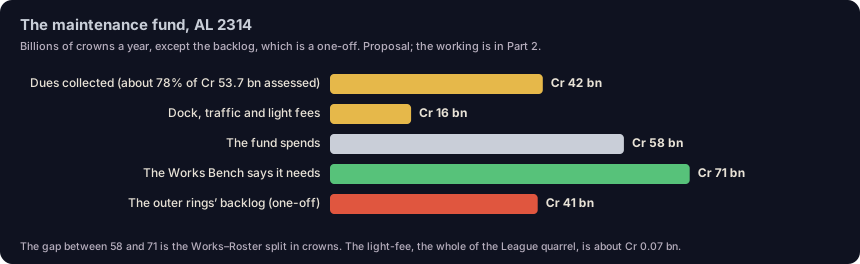
| Cr billion a year | |
|---|---|
| Dues collected (about 78% of the Cr 53.7 billion assessed) | 42 |
| Dock, traffic and light fees | 16 |
| The fund spends | 58 |
| The Works Bench says it needs | 71 |
| The outer rings' backlog (one-off) | 41 |
Working. 11.0 million adult places × Cr 4,400 = Cr 48.4 billion, and 2.4 million child places × Cr 2,200 = Cr 5.3 billion: Cr 53.7 billion assessed. About 78% is collected: Cr 42 billion. 42 + 16 = 58. The Works survey of 2313 puts the need at Cr 71 billion a year and the outer rings' arrears of repair at Cr 41 billion. The Roster's answer is that if every place paid its due, the fund would have about Cr 54 billion in dues alone.
Money#
- The crown, for everything. The Compact issues no currency.
- Due-chits (Chapter VI), at Cr 1.15: the Compact's wages in kind, accepted for dues at par. About Cr 17 billion in chits are outstanding at any time.
- Ring bonds: Cordale's banks and the Stellan Exchange hold the Rings' debt.
- The Tether Yard takes about a fifth of the Docks' trade, and the Compact's fees are set with one eye on it.
Industry#
| Industry | Notes |
|---|---|
| The orbital yards | Torch-freighters and habitat sections (Chapter VI), built from belt metal at Vesper Prime and Ring Twelve. About 14 torch-freighters a year. |
| The Launch Office | About 2,300 launches a year from Pharos Isle and Saltline Launch; the Imperium flies its own from Hesk Point. Working: the Line almanac gives Saltline 41% and Pharos 38% of launches, and the Crown almanac gives Pharos about 1,100 a year, so all spaceports fly about 2,900 and the Launch Office's craft about 2,300. |
| The tenders | About 45 tonnes of helium-3 a year from Kronos (the Kronos colony almanac), about 10 of them for the Crown, carried under the fuel clauses with Fuel Monitors aboard |
| Drop-capsules | Belt metal down into Line lagoons (Chapter VI): about 4,000 capsules a year |
| The farm decks | Half of orbit's food (Chapter VI); fish tanks; the Farms Office |
| Pandia and Ersa | Regolith, oxygen, carbon, and the cheapest launch in the system from Ersa (Chapter III) |
Infrastructure#
| Docks | Vesper Docks: "every drop-capsule and torch-freighter passes through" (the atlas). The Rovessa High Houses' lighter berth. |
| The relays | The relay constellation (2119); the Belt Line to the Cinderbelt (2158), 7 hours each way; Echo at Kronos, 34–52 minutes (chapter 11) |
| Power | Fusion, under Ilyr licence, with power banks for the Shadows |
| Air and water | The Air Guild: recycling at about 98%; belt ice for the rest |
| Habitats | Spin-rings at 0.8–1.0 g (Chapter III); the outer rings at 0.8 g, because their bearings are old |
| Transport | Launch craft, tenders, drop-capsules; between rings, the shuttle ring, a scheduled service round the synchronous belt |
Communications#
- Every off-world message passes through Compact relays, and everyone knows it (Chapter VI, chapter 11). The Imperium's own military relay is the only exception (the Vardane almanac).
- The Relay Guild's oath is that it carries and does not read. The Traffic Office's string-ledger records who sent what to whom, and when, and shows it to the Board. Whether the Compact reads the strings it carries is the system's oldest open question; every power behaves as if it does. (Open. Do not settle it in a scene.)
- The Board Sheet: the Compact's daily, read at watch change on every ring.
- The Unmapping (3 Thaw) is the one day the relays go silent, in honour of the Quiet Sky (Chapter V).
Section 7: Culture, Arts & Daily Life#
Holidays & Celebrations#
| Holiday | Date | Notes |
|---|---|---|
| The Turning | 1 Firstred | The year's first day. Every ring's annual inspection is read out: the Board Reading. A green board is a holiday; a red one is a working day, and a shame. |
| The Unmapping | 3 Thaw | With the planet (Chapter V). The relays fall silent for a day. |
| Landfall Day | 1 Sowing | With the planet (Chapter V). The Founders' Stones are on the ground; the Rings watch the processions on the Weave. |
| The Shadows | About two weeks around each equinox | Not a holiday: the eclipse weeks, when nothing is scheduled and the Power Guild does not sleep. Shadow suppers are eaten by lamplight in the dark minutes. |
| Compact Day | 17 Bloom | The Compact (2068). Every fifth year, the Board's election. |
| Fever's End | 28 Greening | The Quarantine Rules (2236). The Fever Litany: the 40,000 named, ring by ring. |
| Cascade Day | 12 Fall | The Cascade (2066). The Debris Watch reads the tracked list, and the 316 are named. |
| Dues Day | 1 Mist | The annual assessment. The least loved day in orbit. In the outer rings, Dues is performed. |
| Song-Night | Five nights in Mist | With the planet. The Crossing verses are sung facing the window. |
Culinary Traditions#
- Farm-deck greens, beans, deck carp from the fish tanks, and vat protein.
- Hub bread: baked weightless, so that it rises into a sphere. Sliced like an orange.
- Lifted food is "a lift": grain, fruit, meat and wine brought up from Saltline at four times the price. A lift is a present.
- Stair wine on Compact Day, and nothing else that costs so much.
- The outer rings eat vat and greens. A lift in an outer-ring window is a boast.
Arts & Literature#
- Windowcraft: painting on viewport shutters, so that a closed window shows a picture and an open one shows the world.
- The Long View: the planet as the subject of every orbital art. The Cantorate's painters show it green; the Reckoners' show it as weather.
- Watch-songs, sung at watch change; The Turning is one.
- Literature:
- The Cascade (2070): the memoir of Vida Tremblay;
- Green Board (2188): an engineers' novel, and the Polytechnic's set text;
- Dues (2274): a play about an outringing, banned from the Board's own theatre for twenty years and now performed every Dues Day in the outer rings;
- The Seven Years (2293): the idle tenders, 2284–2291, by a tender captain.
Sports & Recreation#
| Sport | Notes |
|---|---|
| Hub-ball | Weightless ball at the hub; the orbital game |
| Rim-running | The ring marathon: once round Vesper Prime's First Ring is about 9.4 km |
| The Gradient | A race from rim to hub up the spokes, with gravity falling all the way |
| Vaulting | The belt's sport, played at the hub by belt families come downring |
The Assembly Games. Upwellers compete downwell, after a few weeks' adjustment (Chapter I). The Compact has won the long jump nine times, and been accused of gravity-cheating every time.
Social Norms & Etiquette#
- Read the board before you speak. Every room has one.
- Never joke about the airlock. The deepest taboo in orbit (Chapter II).
- Never ask what someone owes. Dues are private, and shame.
- A guild card is shown, not mentioned.
- Don't ask a belt visitor when they're going home. The Cinderborn can't (Chapter I).
- Greeting: "Green board?" Reply: "Green, and turning."
- In the Shadows, nothing is decided.
Section 8: Appendices & Reference Materials#
Statistical Tables#
| Indicator | 2068 (the Compact) | 2150 (the Assembly) | 2233 (the Fever) | 2291 (the Armistice) | 2314 |
|---|---|---|---|---|---|
| People in orbit | 40,000 | 1.8 million | 9.1 million | 12.2 million | 14.0 million |
| Major habitats | 6 | 8 | 30 | 36 | 38 |
| Launches a year, all spaceports | about 60 | about 400 | about 1,400 | about 1,900 | about 2,900 |
| Helium-3 carried (tonnes a year) | 0 | about 8 | about 27 | 0 (idle since 2284) | about 45 |
Working. 12.2 million in 2291 to 14.0 million in 2314 is about 0.6% a year: natural growth of 0.36% (Chapter I) and net migration of about 0.2%. 9.1 million in 2233 to 12.2 million in 2291 is about 0.5% a year, after the Fever's 40,000 dead.
Gazetteer#
Every place below is on the interactive Atlas. The generated Register of the Vesper Orbital Compact lists them.
| Place | What it is |
|---|---|
| Belt Line, the | The relay chain to the Cinderbelt |
| Compact Board, the | The Board's chamber, Vesper Prime |
| Echo | The Kronos relay post (Kronos XII) |
| Ersa Station | Carbon mining on Ersa |
| Launch Office, the | The launch-craft fleet |
| Marshals' station, the | The Habitat Marshals' cutters, low orbit |
| Old Vesper | The first station (2034); the Cascade memorial |
| Outer Rings, the | The nine oldest habitats |
| Pandia Regolith Base | Regolith and oxygen on Pandia |
| Polytechnic, the | The guilds' school |
| Red Ring, the | The quarantine station |
| Relay control | The relay constellation's control station |
| Ring Fourteen | Where the Fever began |
| Ring Seven | The guild halls |
| Ring Thirty-One | The outer ring breached in 2307 |
| Ring Twelve | Farm decks and yards |
| Ring Twenty-One | A Crown-flagged ring; the Crown's orbital seats |
| Roster Office, the | The rosters and the dues |
| Tenders, the | The fuel-tender fleet |
| Traffic Control | The Vectors |
| Vesper Docks | The docks |
| Vesper Prime | The seat: seven rings on a spindle |
Bibliography#
In-world sources#
- The Compact of the Orbital Habitats of Vesper (2068) and its four Articles; the Airlock Law (2071); the Quarantine Rules (2236)
- The Cascade (2070), Green Board (2188), Dues (2274), The Seven Years (2293)
- The Board Sheet (daily)
- The Ring Thirty-One Inquiry (2308) and the Works Survey (2313)
- Minutes of the Compact Board, including the Fund's accounts and the Arrears
Development sources#
- 00 - Spine and Status · Chapter I · Chapter II · Chapter III · Chapter IV · Chapter V · Chapter VI
- 11 - Kronos and the Cinderbelt and 15 - The Kronos colony
- The Caldren Crown almanac (the founding, the orbital seats, launches); the Vardane Imperium almanac (Hesk High, the yard and relay outside Compact rule); the Rovessa almanac (the High Houses); the Line almanac (launch shares, the Tether Yard); the Lesser Crowns almanac (Cordale's banks); the Cinderbelt Coalition almanac (the relay request); the Outer Lantern League almanac (the Lanterns, the Settlement, the Arrears, the Dues Order)
- 10 - Who's Who (the flag)
- The faction roster and the relationship register: the Compact's objective, fear, leverage and split, and its positions towards the Rovessa and the League, and theirs towards it
- Almanac structure supplied by Briana.
Guidance for AI actors#
- The Compact is not a state, and its people will correct you. It is an agreement, and its Board is a landlord's board.
- An Upweller can go downwell (Chapter I). A Cinderborn cannot. Do not confuse the two, and neither do they.
- Read the board. A Compact character answers "how are you" with the state of things.
- Never joke about the airlock.
- Engineer or official? Every Compact character is on one side of the Works–Roster split, and knows it.
- Whether the Compact reads the strings is open. Every power acts as if it does. Do not settle it in a scene.
- Nobody fights in the Rings. An orbital battle would break the Rings Truce and the Compact's world; treat any move towards one as the crisis it would be.
- This almanac is approved. Briana approved the whole almanac on 19 September 2026 (the Almanac Approval Decision).