The Definitive Country Almanac: The Free Banner Guild — Part 2#
Kethra Almanac • Approved 19 September 2026 • drafted 19 September 2026 • Sections 5–8 (Sections 1–4 are in Part 1)
Status: approved. Briana approved the whole almanac on 19 September 2026 (the Almanac Approval Decision). Where this file calls something a proposal, read it as approved, except the open points that decision lists.
Status before approval: proposal throughout, except what Part 1 lists as established in earlier files.
Section 5: Government, Law & Politics#
Constitutional Framework#
| Instrument | What it does |
|---|---|
| The Roll of Banners (2149) | The Guild's founding rules: a banner belongs to no state, fights only under written contract, is paid, and keeps its word |
| The Licence Rule (2150) | No hand flies without a state licence and an Accord registration number (Chapter II), and no banner enrols without a chartering state |
| The Hand Rule (2171) | No banner flies a frame without a hand; a breach strikes the banner before the Accord Tribunals sit |
| The Closing of the Roll (2206) | A new banner enrols only with a chartering state and a guarantor |
| The Neutral Roll (2279) | In a war between clients, a banner serves either side, never both in one theatre; the Court hears no case between banners on opposite sides until the war ends |
| The Withdrawal Clause (2292) | No Imperial contract without "a binding exit clause and a solvent guarantor" (the register) |
| The Ledger Rule (2311) | Any banner that takes the Black Ledger's money is struck, and its hands' records voided |
The Roll's rules, as every hand learns them#
| # | Rule | What it means |
|---|---|---|
| 1 | Whose banner? My own. | No banner is a state's. A state may charter it, license its hands and hire it, and may not own it. |
| 2 | Paid. | No work without a written contract; no contract without a price, a term and an exit. |
| 3 | Kept. | A banner that breaks a contract is struck. A client that breaks one is named on the Roll, and no banner takes its next contract. |
| 4 | A hand in every frame. | The Frame Accord, and the Guild's own rule since 2171 |
| 5 | Never bought. | Hired is honourable; bought is struck. The Ledger Rule is this rule with a date on it. |
The Banner Court#
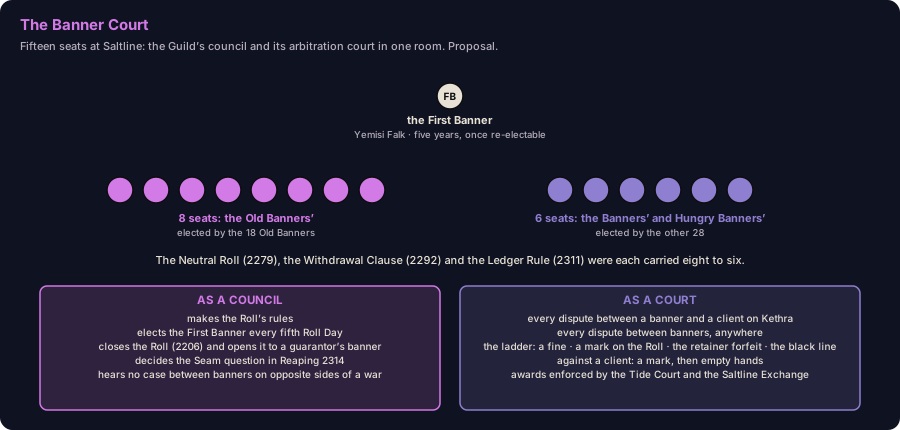
| Seats | Who | How chosen |
|---|---|---|
| 1 | The First Banner, presiding | Elected by the whole Court for five years, once re-electable |
| 8 | The Old Banners' seats | Elected by the eighteen Old Banners |
| 6 | The Banners' and Hungry Banners' seats | Elected by the other twenty-eight |
| 15 | In all |
- Two functions. The Court is the Guild's council, which makes the Roll's rules, and its arbitration court, which hears every dispute between a banner and a client on Kethra, and between banners anywhere. Clients sign to its arbitration in every contract; the Line ports' Tide Court, which hears disputes "between foreigners who choose it" (the Line almanac), and the Saltline Exchange enforce its awards, and the Crown's courts have upheld them since the Coldwell judgment (2289).
- The register's leverage is the Court's: "organised pilots, arbitration and reputational sanctions".
- The register's split is the Court's arithmetic: eight Old-Banner seats to six. "Senior companies can afford principles"; the Neutral Roll, the Withdrawal Clause and the Ledger Rule were all carried eight to six.
Sanctions: the Roll's ladder#
| Sanction | Against a banner | Against a client |
|---|---|---|
| A fine | Paid to the Hall | Paid to the banner |
| A mark on the Roll | A recorded breach, read at Roll Day | The client's name entered with the breach |
| The retainer forfeit | The banner loses its season's Roll due | |
| The black line | The banner is struck, its record published, its hands free to enrol elsewhere with their own records intact | Empty hands: no banner on the Roll takes the client's next contract. Used against House Coldwell (2284–2289). Since the Ledger Rule (2311) it waits for any client the Court finds to have commissioned a betrayal; none has yet been proven, which is the Ledger's whole art. |
Empty hands is not the Rovessa's Empty Roads (the Rovessa almanac), and the Guild says so; but it was written in 2283, the Year of Empty Roads, and the Old Banners had been watching.
The Election of 2314 and the Seam question#
- The election. Yemisi Falk's term ends at the Court of 2314, on Roll Day. She may stand once more. The Old Banners' candidate against her is Torsten Iversen of Iversen's Banner, which keeps Muster; the Hungry Banners have no candidate, and eight votes against six either way.
- The Seam. The Coalition, which pays the Guild more than any other client, has asked for escorts at the Seam's edge, where frames clash every season (chapter 11). The Hungry Banners want the contract. The Old Banners say the Neutral Roll was written for a declared war between states, and the Seam is none: in peace, a banner that fires on the Imperium's frames at the Seam fires on a client whose contracts other banners hold at Muster. Falk has deferred it to the Court. Homeguard faces the same question the same year (the Homeguard almanac), and neither has answered.
- The Requisition Bill (the Assembly almanac) would let the Accord Council requisition "production, docks, relays and hulls" in an emergency. The Guild's ninety-one hulls are hulls. Its position is the Rovessa's: a hired hull is hired; a requisitioned one is bought.
The Judiciary#
- Contract disputes go to the Banner Court, whose awards the Line ports enforce. The Accord Tribunals cannot hear "anything that is not an Accord" (the Assembly almanac), and a contract is not one.
- Accord crimes by a hand go to the Accord Tribunals like anyone else's, and the member state where the crime was done punishes (the Assembly almanac). The Guild strikes first and lets the Tribunals follow.
- Crimes by a hand under contract are tried where they were done, under the client state's law. The Imperium tried the Fourteen of Tolvard for treason, since Imperial law executes only for treason and Accord crimes (the Vardane almanac), and shot them; the Guild's answer was the Withdrawal Clause, not an appeal, because there was no court to appeal to.
- No executions, no prisons: the Guild's worst sentence is the black line.
Foreign Relations & Defence#
Standing#
The Guild has no foreign relations; it has clients, and the powers that will not be clients.
Relations#
The Crown, Imperium and Black Ledger rows follow the relationship register, in both directions.
| Power | Relation | The Guild's view | What each side wants |
|---|---|---|---|
| Caldren Crown | Mercenaries and royal responsibility (the register) | Publicly: "We accept lawful work with enforceable terms." Privately: "A noble's promise may not survive the government blaming outsiders for failure." | The Guild wants "payment, clear scope and legal protection". The Crown wants "reliable service under civilian authority", and privately notes that "their obligations end where the contract ends". What mended it: "the Crown upholds a contract against a powerful noble" (the Coldwell judgment, 2289). What would break it again: "an unpaid operation followed by public scapegoating". In 2314 the Crown wants "Homeguard's escorts on its fuel" (the Homeguard almanac), which would mean fewer of the Guild's. |
| Vardane Imperium | Military demand and independent command (the register) | Publicly: "Command authority must remain within agreed terms." Privately: "They may treat withdrawal at contract expiry as desertion." | The Guild wants "a binding exit clause and a solvent guarantor" (the Withdrawal Clause, 2292). The Imperium wants "operational control when a campaign expands", and privately finds that "refusal to accept permanent command looks unreliable". What would mend it: "a difficult withdrawal honoured without reprisal". What broke it: "a contract extended at gunpoint" (Tolvard, 2286). |
| Black Ledger | Credible contracts versus deniable coercion (the register) | Publicly: "Their methods undermine enforceable employment." Privately: "A client who buys a covert betrayal can make every legitimate contract unsafe." | The Guild wants "exposure of clients who commission betrayal". The Ledger wants "silence, access and pliable subcontractors", and says "the Guild protects its own market under moral language". What would mend it: "specific evidence exonerates a contractor from a disputed attack". What broke it: "a compromised contract kills personnel who relied on agreed terms" (Serrin, 2306). |
| Cinderbelt Coalition | The largest client | "Hired help" (the Coalition almanac): "escorts from Banner Yard". Ore trains to the Anvil, and now the Seam. The Convoy Guard escorts the Coalition's own trains; the Guild takes the rest. | The Coalition wants Seam escorts. The Guild wants the Neutral Roll kept. |
| Vesper Orbital Compact | The steadiest client | The Tide Pennon: "escorts for the tenders since 2284" (the Vesper almanac), on the Seven Years' Retainer and every season since. Homeguard's two hulls escort the Fuel Monitors on the same run (the Homeguard almanac); the Guild's hulls escort Vesper's own tenders. | Vesper wants its tenders escorted and its vectors obeyed; the Guild has never lost a vector. |
| Rovessa Caravans | Escorts by the voyage, "in the Cinderbelt only" (the Rovessa almanac) | Separate hulls beside a carrier, never aboard: carriers "carry no soldier and no weapon of war" (the Rovessa almanac). The Rovessa decline the League's escorts, not the Guild's. | The Rovessa want civilian and military cargo kept apart, and no escort they did not ask for |
| Outer Lantern League | "Rivals, and sometimes recruits" (the League almanac) | Banner Yard's escorts guard the hulls the flints raid; Hob refits anyone's hull, the Guild's included; belt-born hands trained at the Wick Pilots' School enrol at Banner Yard | The Guild has never fired on a Lamp, and the League has never raided a Guild convoy without a fight |
| Homeguard Command | "Contractors kept out" (the Homeguard almanac) | The Two Years' Banner (2150–2152), and eleven refusals since | The Guild wants to lease frames to the Reserve. Homeguard wants no mercenary under the Quiet Star. |
| Homeworld Assembly | "Licensed": "the Frame Accord's contractors" (the Assembly almanac) | The Inspectorate enters every Guild yard without leave, like any other (the Assembly almanac) | The Guild wants the Requisition Bill to leave hired hulls alone |
| Line free ports | Host, and charterer of the Saltline banners | Banner Hall is a guild of Saltline; the Tide Court enforces the Banner Court's awards (proposal); the Neutral Law keeps the ports without a ship of war (the Line almanac), and the Guild's escort hulls are the banners' own, not the ports', and lie outside the reef: nothing armed berths inside a harbour | The ports want the Guild's fees and none of its wars |
| Lesser Crowns | Bankers and charterers | Cordale's banks insure the belt's carriers (the Lesser Crowns almanac); four banners hold Cordalese charters; the Seven themselves hire none | Premiums paid on time |
| Free Oreth coast states | Charterers | The Tessmere yard and the Corridor Pennon | The coast wants its banners at home when the Grey March patrols meet |
| Southern Holds | Work-frames only | Hedge-clearing work-frames (Chapter VI) for Holds free and chartered; "No Hold will pay for another's soldiers" (the Southern Holds almanac) | The Holds fear "northern soldiers" (the Southern Holds almanac), and get none from the Guild |
| Ilyr Sanctum | The licensor behind the licensors | Almost every socket a hand carries is Ilyr's design, fitted under a state's Accord licence and Ilyr's inspection (the Ilyr almanac). Ilyr has never revoked a state's licence over a hired banner's service, even in the Corridor War, when six banners flew for the Imperium it refuses; its Office of Keys calls that the Accord's loophole. | Ilyr's Accord licences go to "Only states that accept Ilyr inspection of their frame works" (the Ilyr almanac), and a guild is not a state, which is why the Guild holds no Ilyr licence of its own |
| The Kronos colony | Muster's neighbour since the Taking, and its customer since 2297 | Muster on sufferance; escorts "for whoever pays, including, sometimes, the Imperium" (the Kronos colony almanac) | The Protector wants the fuel to flow; Muster's hulls help it flow |
Defence: the Roll in arms#
| Where | Banners | Frames | Hulls | Notes |
|---|---|---|---|---|
| Saltline | 9 | 124 | 10 | The Salt Company and the Court's banners |
| Banner Yard | 9 | 124 | 30 | The belt escorts; the Anvil Company |
| The Crown (Thessane) | 8 | 108 | 4 | The Grey Pennon; Crown contract law |
| Muster | 5 | 58 | 22 | Iversen's Banner; the fuel run |
| Cordale | 4 | 55 | 5 | Cordalese charters; the belt insurers' banners |
| The Oreth coast (Tessmere) | 4 | 52 | 4 | The Corridor Pennon |
| Kethra orbit (Vesper Docks) | 4 | 51 | 12 | The Tide Pennon (hulls, mostly) and three banners more, whose frames ride the tender escorts |
| Eldhaven | 3 | 37 | 4 | Civil work-frames since the Armistice; the Blue Pennon |
| In all | 46 | 609 | 91 | About 1,500 hands |
Working. 124 + 124 + 108 + 58 + 55 + 52 + 51 + 37 = 609, the Roll's count. 10 + 30 + 4 + 22 + 5 + 4 + 12 + 4 = 91.
Doctrine. A hand in every frame; a contract for every hand; no bought hand on the Roll. The Guild fights escort actions and border watches, not campaigns; its largest single action in 165 years was the Blue Pennon's convoy of 2284, sixteen frames over twenty-six of House Coldwell's hulls in the Girdle Sea, and it lost it. The Neutral Roll means the Guild has never been on one side of a war between states; the Withdrawal Clause means it has never again been kept in one.
Section 6: Economy, Infrastructure & Industry#
Macroeconomics#
| Metric | Value |
|---|---|
| Contracts | About Cr 6 billion a year across the Roll |
| Per frame | About Cr 10 million a year, which is what a frame costs (Chapter VI): a banner that is not flying is losing its frame |
| The Roll due | 3% of every contract: about Cr 180 million a year for the Hall, the Court and the Salt Field |
| Wages | A hand earns about Cr 60,000 a season under contract, above a Royal Frame Corps lieutenant's Cr 52,000 a year (Chapter VI), and nothing on the retainer but the retainer's share |
| Debt | The Hungry Banners' frames are mortgaged to Cordale's banks and the Saltline Exchange; the Old Banners' are not |
Working. 609 frames × Cr 10 million = Cr 6.1 billion. Cr 6 billion × 3% = Cr 180 million.
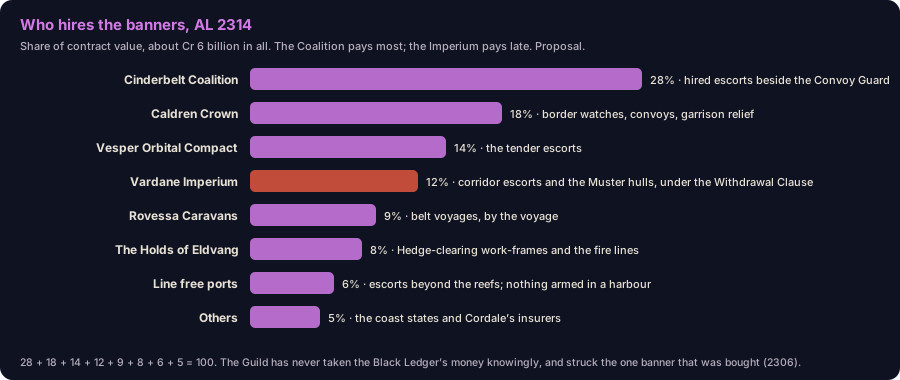
| Client | Share of contracts | What for |
|---|---|---|
| Cinderbelt Coalition | 28% | Hired escorts "as needed", beside the Convoy Guard's own ore trains: "Escorts from Banner Yard" (the Coalition almanac) |
| Caldren Crown | 18% | Border watches, convoy escorts, garrison relief: "recognised contractors who supplement royal forces" (the Crown almanac) |
| Vesper Orbital Compact | 14% | The tender escorts (the Vesper almanac) |
| Vardane Imperium | 12% | Corridor escorts and the Muster hulls, under the Withdrawal Clause |
| Rovessa Caravans | 9% | Belt voyages, by the voyage (the Rovessa almanac) |
| The Holds of Eldvang, free and chartered | 8% | Hedge-clearing work-frames (Chapter VI) and fire-line work in the ember season |
| Line free ports | 6% | Escorts beyond the reefs for the ports' own shipping, and quarantine tows; nothing armed inside a harbour, where the Neutral Law lets a port keep no ship of war (the Line almanac) |
| Others | 5% | The coast states and Cordale's insurers |
Money#
- The crown, for every contract (Chapter VI); Imperial contracts are written in crowns too, since 2292, so that the guarantor is solvent in a currency the Court can enforce.
- Insurance at the Saltline Exchange and Driftmark (the Line almanac), and at Cordale's banks for the belt (the Lesser Crowns almanac). A banner that is struck loses its cover the same day.
- The retainer: a client may pay a banner not to fly, and Vesper did for seven years. The Roll takes its due on a retainer as on a contract.
Industry#
| Frames | Bought new from the Thessane Works (Chapter VI); refitted at Banner Yard and at the League's Hob, "no questions asked" (the League almanac). Seldom from Kessard, and only for the hands who came from the Imperial Corps: the Imperium's frames are built "on designs licensed before 2150 and on Kessard's own work" (the Ilyr almanac), outside Ilyr's Accord licences, which are "Refused to the Imperium", though an Imperial socket carries an Accord registration number like any other (the Assembly almanac). |
| Hulls | From Pellmoor's Westhaven yards (the Lesser Crowns almanac) and the Coalition's; the Tide Pennon's are Vesper-built |
| Sockets | Ilyr designs under each state's Accord licence (the Ilyr almanac), fitted at the licensing state's socket clinic; the Salt Field's surgeons fit nothing, and keep sockets within licence |
| The Salt Field | Drill, trials and the Roll examination |
Infrastructure#
| Banner Hall and the Court | Saltline |
| The yards | Thessane, Cordale, Tessmere, Eldhaven; the Tide Pennon's berth at Vesper Docks |
| Banner Yard | The belt: a hollowed rock, 8,000 people, the Guild's only infirmary off Kethra |
| Muster | Kronos XIV: a depot of hulls and 13,000 people, 34–52 minutes from Kethra by signal (chapter 11), through Echo, Vesper's relay at Kronos (the Who's Who) |
| Relays | None. Belt contracts travel as strings on the Belt Line, seven hours each way (Chapter VI), and Vesper carries them (chapter 11); whether it reads them is open (the Vesper almanac), and the Guild writes every belt contract as if it does: short, standard, and fit to be read. |
Communications#
- The Roll Sheet, published at each season's turn: contracts let, banners marked, banners struck.
- The hiring floor at Banner Hall, where clients post contracts by the season and banners bid.
- Strings to the belt (Chapter VI). Banner Yard decides for itself within the Roll's rules, and answers to the Court a season late.
Section 7: Culture, Arts & Daily Life#
Holidays & Celebrations#
| Holiday | Date | Notes |
|---|---|---|
| Roll Day | 9 Reaping | The Roll of 2149. The Roll-Call is sung at the Court's opening; the struck names are read last, in silence. The First Banner is elected every fifth year. |
| The Day of the Hand | 4 Thaw | The Imperium's Iron Winter remembrance (the Vardane almanac), kept at every Guild yard with a hand raised in the canopy |
| The Tolvard Fourteen | 22 Highsun | The hands shot in 2286, named at Tessmere |
| The Hiring | The first week of each season | Contracts posted at the Hall; the banners bid |
| Landfall Day and the Unmapping | 1 Sowing; 3 Thaw | With the planet (Chapter V) |
Culinary Traditions#
Banner-folk eat what their contract feeds them: Line rice at Saltline, vat protein at Banner Yard as on every rock in the belt (the League almanac), gorge bread on an Imperial corridor (the Vardane almanac). Contract bread is the Guild's own: a loaf baked at the Hall on the day a contract is signed, broken between the banner and the client's agent. A client who will not break bread is a client the Old Banners will not take.
Arts & Literature#
- The banners themselves: each company's pennon is cut and sewn by its own hands, and a struck banner's pennon is burned at the Court's door.
- The Roll-Call, sung; and the retainer songs, the belt escorts' songs of waiting.
- Literature:
- The Roll (2149): Corbin Greyhawk's rules, in a page and a half;
- Whose Banner? (2237): a play about the Two Years' Banner, performed at Saltline every Roll Day;
- Fourteen (2293): the Tolvard Extension, by a survivor of the Tessmere Pennon;
- The Retainer (2298): seven years of not sailing, by a Tide Pennon hull-master.
Sports & Recreation#
| Sport | Notes |
|---|---|
| The Banner Trials | Every Roll Day at the Salt Field: banners against banners in frame trials, judged for control. The Homeguard Trials at Thessane (the Homeguard almanac) are the state version, and Guild hands may not enter them. |
| Hull races | Banner Yard against Muster, by string and a season apart |
| Frame-racing at the Thessane Ring | The Crown's sport (the Crown almanac); Guild hands race under their own banners |
Social Norms & Etiquette#
- "Whose banner?" "My own." The greeting, and the creed.
- Never call a hand bought. It is the Guild's one fighting word.
- Never ask a hand whose contract. Saltline's rule, "never ask whose side someone is on" (the Line almanac), is the Guild's.
- Break bread on a contract, or do not sign it.
- A struck banner is not named except on Roll Day.
- The hand is returned. The pilots' salute, the right palm flat over the heart (the Homeguard almanac), is returned to any pilot of any flag, and to no one else.
Section 8: Appendices & Reference Materials#
Statistical Tables#
| Indicator | 2149 (the Roll) | 2200 | 2250 | 2291 (the Armistice) | 2314 |
|---|---|---|---|---|---|
| Banners on the Roll | 14 | 22 | 33 | 39 | 46 |
| Frames | about 90 | about 210 | about 380 | about 470 | about 609 |
| Escort hulls | 0 | 12 | 40 | 66 | 91 |
| Contracts (Cr billion a year, at 2314 prices) | 0.4 | 1.4 | 3.1 | 4.6 | 6.0 |
| Banners struck (cumulative) | 0 | 4 | 9 | 14 | 19 |
The Roll of Banners (complete)#
46 banners in AL 2314, in order of enrolment. "Home" is the yard where the banner is chartered and winters; "Enrolled" is the year it signed the Roll; "Standing" is its place on it. Of the fourteen banners that signed in 2149 only the Salt Company still flies: the rest merged, dissolved or were struck, and nineteen banners in all have had the black line. (All proposal. Generated from a fixed seed with mixed name pools; see the naming principles.)
| # | Banner | Home | Enrolled | Frames | Standing | Notes |
|---|---|---|---|---|---|---|
| 1 | the Salt Company | Saltline | 2149 | 24 | Old Banner | The first banner; Corbin Greyhawk’s company. Yemisi Falk’s. |
| 2 | the Grey Pennon | Thessane | 2151 | 22 | Old Banner | The Two Years’ Banner: hired by the Crown and lent to Homeguard, 2150–2152; enrolled the year between. |
| 3 | Iversen’s Banner | Muster | 2155 | 14 | Old Banner | Keeps Muster. Escorts for whoever pays, sometimes the Imperium (the Kronos colony almanac). |
| 4 | Jakande’s Banner | Banner Yard | 2155 | 20 | Old Banner | |
| 5 | the Reef Pennon | Saltline | 2156 | 15 | Old Banner | |
| 6 | Lindstrom’s Banner | Tessmere | 2168 | 14 | Old Banner | |
| 7 | Underhill’s Banner | Thessane | 2170 | 16 | Old Banner | |
| 8 | the Rime Company | Saltline | 2172 | 13 | Old Banner | |
| 9 | the White Pennon | Cordale | 2172 | 22 | Old Banner | |
| 10 | Kettering’s Banner | Cordale | 2172 | 22 | Old Banner | |
| 11 | the Salt Pennon | Saltline | 2174 | 17 | Old Banner | |
| 12 | the Blue Pennon | Eldhaven | 2174 | 16 | Old Banner | Escorted House Coldwell’s convoy (2284) and was vindicated by the High Bench (2289). Work-frames since the Armistice. |
| 13 | Carvalho’s Banner | Vesper Docks | 2174 | 13 | Old Banner | |
| 14 | Vasconcelos’s Banner | Banner Yard | 2184 | 24 | Old Banner | |
| 15 | the Anvil Company | Banner Yard | 2190 | 18 | Old Banner | Founded Banner Yard. Convoy escorts for the Coalition and the Rovessa. |
| 16 | the Twentieth Banner | Vesper Docks | 2195 | 17 | Old Banner | |
| 17 | the Thirteenth Banner | Muster | 2196 | 16 | Old Banner | |
| 18 | the Fifth Banner | Banner Yard | 2197 | 16 | Old Banner | |
| 19 | the Lane Company | Banner Yard | 2202 | 12 | Banner | |
| 20 | Solberg’s Banner | Saltline | 2206 | 16 | Banner | |
| 21 | Nakagawa’s Banner | Thessane | 2217 | 13 | Banner | |
| 22 | the Seventh Banner | Saltline | 2225 | 11 | Banner | |
| 23 | Tremaine’s Banner | Muster | 2225 | 13 | Banner | |
| 24 | the Eleventh Banner | Thessane | 2226 | 13 | Banner | |
| 25 | the Ring Company | Vesper Docks | 2226 | 15 | Banner | |
| 26 | the Iron Pennon | Banner Yard | 2228 | 9 | Banner | |
| 27 | Quayle’s Banner | Tessmere | 2231 | 14 | Banner | |
| 28 | Yilmaz’s Banner | Muster | 2239 | 8 | Banner | |
| 29 | Eriksen’s Banner | Saltline | 2241 | 14 | Banner | |
| 30 | the Tether Company | Banner Yard | 2245 | 10 | Banner | |
| 31 | the Third Banner | Eldhaven | 2250 | 8 | Banner | Work-frames. |
| 32 | the Brine Company | Thessane | 2257 | 11 | Banner | |
| 33 | the Long Company | Tessmere | 2257 | 15 | Banner | |
| 34 | the Copper Pennon | Thessane | 2259 | 16 | Banner | |
| 35 | the Rift Company | Eldhaven | 2263 | 13 | Banner | Work-frames. |
| 36 | the Twenty-First Banner | Cordale | 2279 | 5 | Hungry | |
| 37 | the Thirtieth Banner | Banner Yard | 2279 | 8 | Hungry | |
| 38 | Gaunt’s Banner | Thessane | 2283 | 9 | Hungry | |
| 39 | the Tide Pennon | Vesper Docks | 2284 | 6 | Banner | Vesper’s tender escorts since 2284 (the Vesper almanac). Hulls, not frames, mostly. On the retainer from its first season, and free of its guarantor at once. |
| 40 | the Quay Company | Cordale | 2285 | 6 | Hungry | |
| 41 | the Corridor Pennon | Tessmere | 2286 | 9 | Banner | Formed from the survivors of the Tolvard Extension, as the Tessmere Pennon re-enrolled; its guarantor was the Tessmere Senate’s relief fund, discharged in 2292. |
| 42 | the Ember Company | Muster | 2286 | 7 | Hungry | |
| 43 | the Ninth Banner | Saltline | 2289 | 6 | Hungry | |
| 44 | the Amber Pennon | Thessane | 2299 | 8 | Hungry | |
| 45 | Zubair’s Banner | Saltline | 2300 | 8 | Hungry | |
| 46 | the Green Pennon | Banner Yard | 2302 | 7 | Hungry |
Gazetteer#
Every place below is on the interactive Atlas. The generated Register of the Free Banner Guild lists them.
| Place | What it is |
|---|---|
| Banner Court, the | Arbitration and council, Saltline |
| Banner Hall | The Guild's headquarters, Saltline |
| Banner Yard | The escort-contract base in the belt |
| Guild hall, Eldhaven | Civil work-frames for Hedge-clearing and the fire lines, for Holds free and chartered |
| Guild yard, Cordale | The Cordalese-chartered banners |
| Guild yard, Tessmere | The coast banners; the Corridor Pennon |
| Guild yard, Thessane | The Crown-chartered banners; the Grey Pennon |
| Muster | The staging depot, Kronos XIV |
| Salt Field, the | The frame ground and the Roll examination |
| Tide Pennon's berth, the | The Compact's escort contractor, Vesper Docks |
Bibliography#
In-world sources#
- The Roll of Banners (2149) and its rules; the Neutral Roll (2279); the Withdrawal Clause (2292); the Ledger Rule (2311)
- Whose Banner? (2237), Fourteen (2293), The Retainer (2298)
- The Roll Sheet (each season)
- The Coldwell judgment (High Bench of the Crown, 2289)
- Minutes of the Banner Court, including the Serrin case (2306–)
Development sources#
- 00 - Spine and Status · Chapter I · Chapter II · Chapter IV · Chapter V · Chapter VI
- 10 - Who's Who, 11 - Kronos and the Cinderbelt and 15 - The Kronos colony
- The clients' almanacs: the Crown, the Imperium, the Coalition, Vesper, the Rovessa, the League, the Line ports, the Lesser Crowns, the coast states, the Southern Holds, the Ilyr Sanctum, the Assembly and Homeguard
- The faction roster and the relationship register: the Guild's objective, fear, leverage and split, and its positions towards the Crown, the Imperium and the Black Ledger, and theirs towards it. The register's Guild–Wayfarer Exchange entry is not used: the Wayfarer Exchange belongs to a later era (the Who's Who).
- Almanac structure supplied by Briana.
Guidance for AI actors#
- A banner is hired, never owned. A Guild character serves a contract, not a cause, and says so; the insult for the alternative is "bought".
- Whose banner? My own. Never ask a hand whose contract they are on; it is Saltline's rule and the Guild's.
- The Neutral Roll holds. In a war between states, a Guild character may be on either side, never both in one theatre, and may meet another banner across the line; the Court will hear no case between them until the war ends.
- The Ledger is the enemy that does not sign. Any scene in which a banner is offered money to stand down is the Serrin betrayal happening again, and every hand knows it.
- The Seam question is open: whether the Court lets a banner take the Coalition's Seam contract. Do not settle it in a scene.
- This almanac is approved. Briana approved the whole almanac on 19 September 2026 (the Almanac Approval Decision).