The Definitive Country Almanac: The Free Banner Guild — Part 1#
Kethra Almanac • Approved 19 September 2026 • drafted 19 September 2026 • Sections 1–4 (Sections 5–8 are in Part 2)
Status: approved. Briana approved the whole almanac on 19 September 2026 (the Almanac Approval Decision). Where this file calls something a proposal, read it as approved, except the open points that decision lists.
Status before approval:
- Established in earlier files, and taken as given here (proposals there too, unless the spine's canon table covers them):
- The name Free Banner Guild, approved by Briana. The faction roster's role note, which describes the source material rather than a decision about Kethra, reads "Professional mercenaries; a continuing conflict with" the faction the roster names the Black Ledger.
- "Licensed mercenary frame companies" (the spine). "Licensed mercenary frame companies: Banner Yard in the belt, Muster at Kronos. They work for whoever pays." (The Who's Who.) A "Mercenary association" (the register).
- Banner Yard, in the Cinderbelt: about 8,000 people, "the escort-contract base. Convoy protection for anyone who can pay" (chapter 11). Muster, Kronos XIV: 22.3 million km from Kronos, a 680-day orbit, about 14 km across, "a staging depot for escort contracts, open to whoever pays" (chapter 11); about 13,000 people, "mercenary staging", one of the "free and holdout moons" outside Vardane administration; "escorts for whoever pays, including, sometimes, the Imperium" (the Kronos colony almanac). A Free Banner foothold remains at Kronos after the occupation (the spine).
- The Frame Accord (AL 2150): "No frame without a hand"; every armed frame carries a linked human pilot; "autonomous weapons, and weapons controlled remotely beyond line of sight, are banned" (Chapter II). Link-socket licensing: "Neural implants for frame piloting require a state licence and an Accord registration number. Unlicensed sockets ('black sockets') are a serious crime in the Crown and common in the belt." (Chapter II.) Ilyr's Accord licences for piloted defensive frames go to "Only states that accept Ilyr inspection of their frame works", and are "Refused to the Imperium since 2150" (the Ilyr almanac). In the Crown, the Frame Licensers, a chartered guild, train pilots and inspect frames (Chapter VI), and the Thessane Works' frames go to the "Royal Frame Corps / civil buyers / Free Banner Guild" (Chapter VI).
- The Crown: "Recognised contractors who supplement royal forces | Service under civilian authority"; "Contractors | Free Banner Guild companies, under the Frame Accord and Crown contract law" (the Crown almanac). The Imperium: "Useful. Imperial commanders want operational control. | Command of hired companies once a campaign widens" (the Vardane almanac). The Coalition: "Hired help | Escorts from Banner Yard" (the Coalition almanac). The Rovessa hire "Free Banner Guild escorts, hired by the voyage", "in the Cinderbelt only" (the Rovessa almanac). Vesper: "Hired escorts | Escorts for the tenders since 2284" (the Vesper almanac). The League: "Rivals, and sometimes recruits | Banner Yard escorts the hulls the flints would rather raid" (the League almanac). Homeguard: "Contractors kept out | No mercenary company has served under the Quiet Star since 2152" (the Homeguard almanac). The Assembly: "Licensed | The Frame Accord's contractors" (the Assembly almanac).
- From the register: its objective is to keep contracts enforceable and independent pilots employable; its fear is clients turning hired pilots into disposable political scapegoats; its leverage is organised pilots, arbitration and reputational sanctions; its split is that poorer companies need immediate work, while senior companies can afford principles. Its positions towards the Caldren Crown, the Vardane Imperium and the Black Ledger, and theirs towards it, are used throughout. Its register entry towards the Wayfarer Exchange is not used: that faction belongs to a later era (the Who's Who).
- Proposal: everything else. It is built on the spine, Chapters II, V and VI, chapter 11, the Who's Who and the almanacs of every client. The Tide Pennon, the Seven Years' Retainer and the Grey Pennon's two years are this almanac's; the Vesper and Homeguard almanacs now mention them on its authority.
- Two things settled here that earlier files left open. Who licenses the Guild, and the answer is nobody: each banner is a company chartered under the law of the place it winters; each hand holds a personal state licence and Accord registration number from the state that trained them (Chapter II), with a socket fitted at that state's clinic under Ilyr's inspection (the Ilyr almanac); and the Guild itself licenses no one, because Ilyr's Accord licences go only to states. (That the Cinderbelt Coalition, an associate of the Assembly and not a member, licenses pilots under the Accord is this almanac's proposal.) And why the Guild still holds Muster after the Imperium "seized the Kronos moons in one operation" in 2284 (the Kronos colony almanac): Muster was not worth a landing; the Coalition's Taking Embargo (2284–2297: the Coalition almanac) kept its hulls out of Imperial service until 2297; and the Imperium has hired from it since, and tolerates it as it tolerates Holdfast.
Reading note. The Guild is not an army and not a country. It is a roll of forty-six small companies, called banners, each of which will fight for whoever pays, and one court at Saltline that makes sure they are paid, and that they keep their word. Its whole politics is the difference between a hand that is hired and a hand that is bought. Every Guild place named here is on the interactive Atlas; Banner Yard is on the Cinderbelt map and Muster on the Kronos map. The full list is the generated Register of the Free Banner Guild.
Section 1: National Overview & Identity#
Official Name & Etymology#
- Formal name: The Free Banner Guild of Kethra, as the Roll of 2149 is titled.
- Short name: the Guild. Its companies are banners; its licensed pilots are hands; the register of its companies is the Roll of Banners.
- People: banner-folk. The adjective is Guild or free: "a free hand", "a free banner".
Where the name comes from. The Iron Winter was fought by mixed-nation frame companies (the Crown almanac), and each company flew a banner of its own because it had no state's flag to fly. When the war ended in 2146 and the companies were sent home, the pilots who had no home to be sent to kept their banners, and hired them out. In 2149 fourteen such companies met at Saltline, a harbour that asked no one whose side they were on (the Line almanac), and wrote the Roll: a free banner is a company that belongs to no state, fights under contract, and is paid. "Guild" was Saltline's word for it; the Line ports are governed by guilds and ship-owners (the Line almanac), and a company that wanted a berth there needed to be one.
What others call it:
| Who | Name | Meaning |
|---|---|---|
| The Caldren Crown | "the contractors" | "Recognised contractors who supplement royal forces" (the Crown almanac) |
| The Vardane Imperium | "the hired companies"; in Orethi, "the bought hands" | Useful, and not trusted with a command: "Imperial commanders want operational control" (the Vardane almanac) |
| The Cinderbelt Coalition | "the escorts", "Banner Yard" | "Hired help" (the Coalition almanac) |
| The Outer Lantern League | "the paid hands" | Rivals on the same lanes: "Banner Yard escorts the hulls the flints would rather raid" (the League almanac) |
| The Rovessa | "the escort" | Hired by the voyage, in the belt only (the Rovessa almanac) |
| The Line ports | "the Guild" | A guild of Saltline, like any other |
| The frontier (Kethra) | "the northern frames" | Hedge-clearing work-frames for hire, and no soldiers: the Holds' fear is "northern soldiers" (the Southern Holds almanac) |
| An insult | "bought" | The worst thing a hand can be called: a hired hand is paid, a bought hand is owned |
| Themselves | "the Roll", "free hands" |
Greeting, between hands: "Whose banner?" Reply: "My own." It began as a challenge on the Iron Winter's roads, and is now the Guild's whole creed in four words.
National Symbols#
| Symbol | Description | Meaning |
|---|---|---|
| Flag: "the Free Pennon" | On banner purple, a pale staff bearing a magenta swallow-tailed pennon (the Who's Who) | A banner with no state's device on it. Name check: the name comes from the Iron Winter companies' banners; the swallow-tail is the Line ports' hiring pennon, flown from a mast to say a hull is free to charter. Different sources, as the naming principles require. |
| Emblem | The swallow-tail | Cut into every banner's pennon, whatever else it shows |
| Motto | Paid, and Kept | A contract paid, and a contract kept: the Roll's two rules |
| Anthem | The Roll-Call: the forty-six banners named in order of enrolment, sung at the Banner Court's opening | |
| Colours | Banner purple, pale, and each banner's own |
The State Profile#
| Seat | Banner Hall, Saltline, on the Line: "headquarters of the Free Banner Guild on Kethra" (the atlas). The Banner Court sits beside it. |
| Head | First Banner Yemisi Falk, of the Salt Company, since 2309. The Banner Court elects the First Banner for five years, once re-electable; her term ends at the Court of 2314. (Proposal.) |
| The Roll | 46 banners: 18 Old Banners (enrolled by 2200), 19 Banners, and 9 Hungry Banners (enrolled since 2271, and still under a guarantor's bond) |
| Strength | About 609 frames and 91 escort hulls; about 1,500 licensed hands; about 22,000 banner-folk on Kethra and in orbit, counting hands, ground crews, hull crews, the Hall and their households, and about 21,000 more people at Banner Yard and Muster |
| Where | Each banner is a company chartered under the law of the place it winters: 9 at Saltline, as Saltline companies under its Council of Owners and Masters (the Line almanac); 8 at Thessane, by royal charter; 4 at Cordale; 4 at Tessmere; 3 at Eldhaven, by the Hold's Moot; 9 at Banner Yard and 5 at Muster, as yard-companies under Coalition law (the Coalition almanac); and 4 at Vesper Docks, by royal charter. Each hand carries a personal licence from the state that trained them. (Proposal.) |
| Language | Linecant at the Hall (Chapter IV); the pilots' link-cant everywhere |
| Money | The crown. Contracts are written in crowns and settled through the Saltline Exchange (the Line almanac); the Guild takes a Roll due of 3% of every contract for the Hall and the Court. |
| Time | Contracts run by the season: Sowing, Highsun, Reaping and Kindling terms. Belt contracts are a season long because a season is how long a freighter takes (the Coalition almanac). |
| Standing | No seat anywhere. "Licensed", in the Assembly's eyes: "the Frame Accord's contractors" (the Assembly almanac). Each banner is a chartered company where it winters; the Guild is their association, and a guild of Saltline. |
Chronological Timeline#
| AL | Event |
|---|---|
| 2141–2146 | The Iron Winter. Mixed-nation frame companies destroy "the rogue Vardane corridor machines" (the Crown almanac), which the Imperium calls the Sentinels (the Vardane almanac). Each company flies its own banner. |
| 2146–2148 | The free banners: demobilised pilots with no state to go home to hire out their banners along the Line |
| 2149 | The Roll of Banners (9 Reaping): fourteen companies found the Free Banner Guild at Saltline. Corbin Greyhawk of the Salt Company is the first First Banner. |
| 2150 | The Frame Accord. Every hand must now hold a state licence and an Accord registration number (Chapter II), and the Roll writes the Licence Rule: no hand flies without them, and no banner enrols without a chartering state. The Two Years' Banner: the Grey Pennon, hired by the Crown, serves in the Crown's contingent to the new Homeguard Command. |
| 2152 | The Crown stops lending the Grey Pennon with its contingent: the Contingent Rules (2151) are read to bar hired companies from lent units, and "no mercenary company has served under the Quiet Star since 2152" (the Homeguard almanac) |
| 2155 | Muster, a captured rock no one had worked, is leased from the Coalition's Kronos Fuel Authority, which claimed every Kronos moon (chapter 11) and worked only Hearthport (the Coalition almanac), as a staging depot for escort contracts |
| 2171 | The Sethe drones: the first Accord Tribunal (the Assembly almanac). The Roll adds a rule of its own, the Hand Rule: no banner flies a frame without a hand, on pain of striking. |
| 2190 | Banner Yard founded in the belt, two years after Castellan Rock (the Vardane almanac) |
| 2206 | The Roll is closed to unlicensed companies; the Closing of the Roll: a new banner enrols only with a chartering state and a guarantor |
| 2229 | The Brisk Foundry revocation grounds every Crown frame works for fourteen months (the Ilyr almanac); the Crown's banners with them |
| 2233–2236 | Vesper Fever. Guild hulls carry the quarantine crews between ports. |
| 2262 | The Serell socket ring: 214 convictions (the Assembly almanac). Three banners are struck from the Roll for black sockets. |
| 2279–2291 | The Corridor War. The Guild declares the Neutral Roll: a banner may serve either side, never both in one theatre, and the Court hears no case between banners on opposite sides until the war ends. Twelve banners serve the Crown, six the Imperium, all six of them Saltline- or coast-chartered. |
| 2284 | The Coldwell case: House Coldwell, one of the 96 Chartered Houses (the Crown almanac), refuses to pay the Blue Pennon for a convoy lost to Imperial raiders in the Girdle Sea, and the war government blames the hired company in the Hall of Voices. Vesper hires the Tide Pennon to escort its fuel tenders, which then do not sail for seven years (the Vesper almanac): the Seven Years' Retainer. |
| 2286 | The Tolvard Extension. The Imperial commander at Tolvard holds the Tessmere Pennon past its contract, calls withdrawal desertion, and has fourteen hands who try to leave tried for treason and shot, since Imperial law executes only for treason and Accord crimes (the Vardane almanac). The survivors are released at the Armistice and re-form at Tessmere as the Corridor Pennon. |
| 2289 | The Coldwell judgment: the Crown's High Bench upholds the Blue Pennon's contract against House Coldwell |
| 2291 | The Armistice of Saltline. The Tide Pennon's escorts sail at last. |
| 2292 | The Withdrawal Clause: no banner signs an Imperial contract without a binding exit clause and a solvent guarantor |
| 2299 | The Long Dark: the League's Light doused for 61 days (the League almanac); Banner Yard's convoys idle with everyone else's |
| 2306 | The Serrin betrayal. A banner escorting a Serrin corridor company's train stands down for money, and in the gap the work is done that the Guild lays to the Black Ledger: 41 dead, nine of them the banner's own hands. The Guild's first expulsion for a buy-off. |
| 2311 | The Ledger Rule: any banner that takes the Ledger's money is struck, and its hands' Roll records voided |
| 2313 | The Lamp Hunt: Banner Yard's convoys stopped and searched in the South Lane (the League almanac). Homeguard refuses the Guild's offer to lease frames for its Reserve. |
| 2314 | The present. The Requisition Bill (the Assembly almanac) would let the Assembly requisition hulls. The Seam skirmishes every season, and the Coalition asks for Seam escorts. The Banner Court of 2314 will elect a First Banner, and hear the Serrin case's last appeal. |
Section 2: Geography & Environment#
Physical Geography#
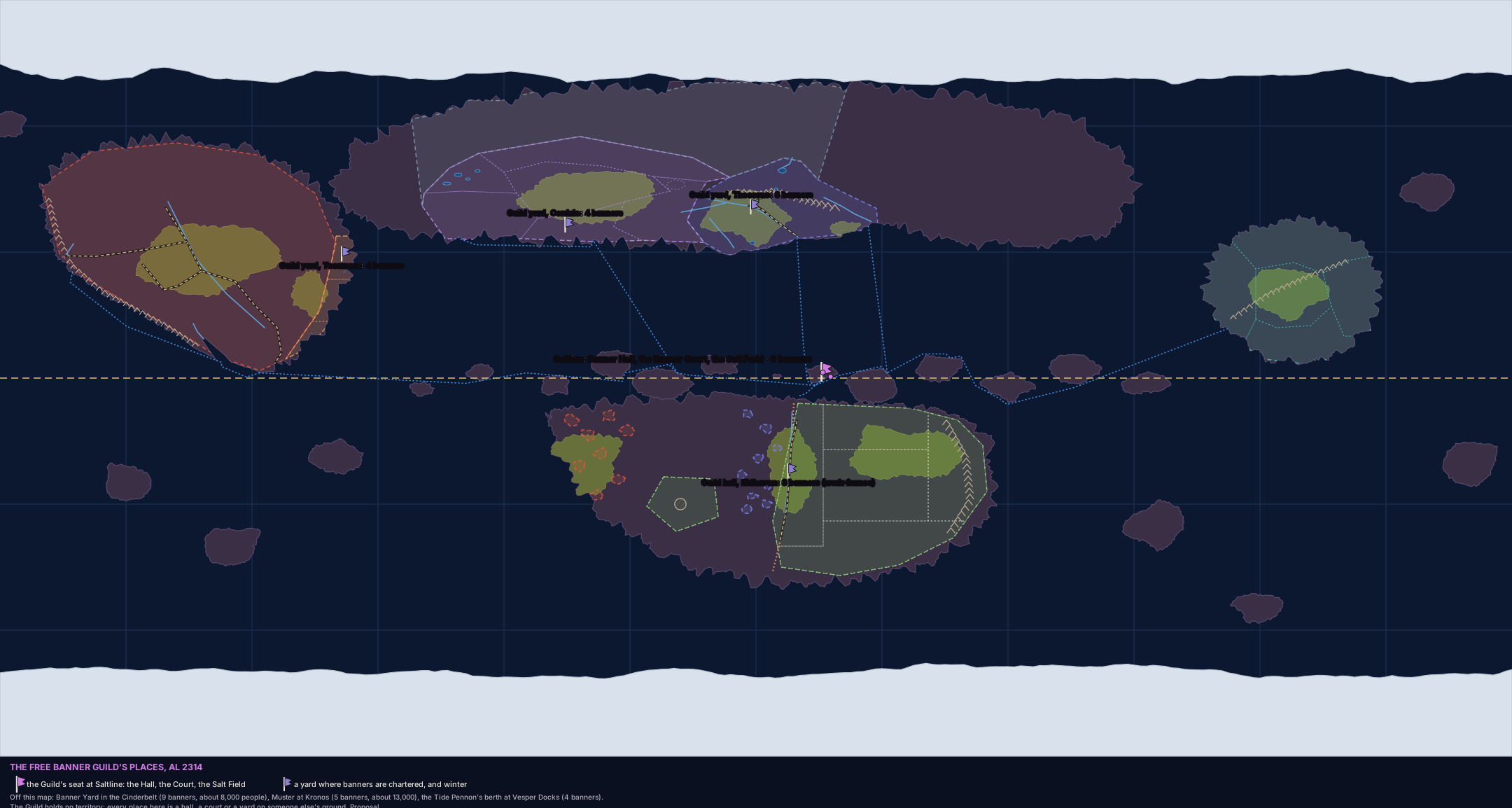
The Guild holds no ground of its own. It holds a hall on neutral ground, a rock in the belt, a moon on sufferance, and yards where its banners are chartered.
| Place | Where | What it is |
|---|---|---|
| Banner Hall | Saltline, North Isle | The Guild's headquarters (the atlas): the Roll, the Hall's treasury, the hiring floor |
| The Banner Court | Saltline, beside the Hall | Arbitration and council; every dispute between a banner and a client on Kethra is heard here |
| The Salt Field | Saltline, South Isle, beside the salt pans (the Line almanac) | The Guild's frame ground: drill, trials, and the Guild's own examinations, which add nothing to a state licence and mean more on the Roll |
| Guild yard, Thessane | The Crown, beside the Thessane Works (the Crown almanac) | The Crown-chartered banners' yard; the Works sells them their frames |
| Guild yard, Cordale | The Lesser Crowns | Banners chartered under Cordalese contract law, whose banks insure their belt work (the Lesser Crowns almanac). The Seven themselves hire no banners. |
| Guild yard, Tessmere | The Oreth coast | The coast banners, and the Corridor Pennon |
| Guild hall, Eldhaven | Eldhaven, on the Eldvang rift, where the Holds Compact meets (the Southern Holds almanac) | Civil work-frames for Hedge-clearing (Chapter VI) and the fire lines of the ember season, hired by Holds free and chartered. "No Hold will pay for another's soldiers" (the Southern Holds almanac), and the Guild sends none. |
| The Tide Pennon's berth | Vesper Docks | The Compact's escort contractor: "Escorts for the tenders since 2284" (the Vesper almanac) |
| Banner Yard | The Cinderbelt | About 8,000 people; "the escort-contract base" (chapter 11) |
| Muster | Kronos XIV | About 13,000 people; "mercenary staging" (the Kronos colony almanac) |
Banner Yard and Muster#
Banner Yard was hollowed in 2190 on the southern edge of the Coalition's side of the belt, between the yards and the South Lane, so that its escorts could reach the ore trains, the Rovessa's Wick berth and the Seam. It is a company town of nine banners, and, like every belt rock, a place where the Hollows kill (Chapter I) and black sockets are common (Chapter II). The Guild has never let a black socket fly under a banner; it has struck three banners for them.
Muster is a captured rock about 14 km across on a 680-day orbit far out from Kronos (chapter 11). The Coalition's Kronos Fuel Authority, which claimed every Kronos moon (chapter 11) and worked only Hearthport (the Coalition almanac), leased it to the Guild in 2155 as a depot for escort contracts on the fuel run. When the Imperium "seized the Kronos moons in one operation" in 2284 (the Kronos colony almanac), Muster, 22 million km out, was not worth a landing. Its banners are yard-companies under Coalition law, and while the Coalition's Taking Embargo stood (2284–2297: the Coalition almanac) no Muster hull served the Imperium. The Imperium has hired from it since, "sometimes" (the Kronos colony almanac), and tolerates it as it tolerates the Coalition's Holdfast. Muster's people are mostly hull crews between contracts, and the Guild counts about 13,000 of them.
"Climate"#
The Guild's weather is its clients'. Its year is the four contract seasons; its winters are wherever a banner's charter is. A banner-hand who has never seen an ember storm (the Southern Holds almanac) has flown a work-frame on the fire line of one from Eldhaven; one who has never seen the Girdle Sea has escorted a carrier across it.
Life and Resources#
| Resource | Where | Notes |
|---|---|---|
| Frames | Bought from the Thessane Works (the Crown: "about 1,400 frames/year: 1,100 civil, 300 military", Chapter VI) and, seldom, Kessard; salvage refitted at the belt's yards | A military line frame costs Cr 9–14 million (Chapter VI); the Roll's 609 are worth about Cr 6 billion |
| Hulls | Escort hulls from Pellmoor's Westhaven Naval Yard (the Lesser Crowns almanac) and the Coalition's yards | 91 in all |
| Hands | Each licensed by the state that trained them, and registered under the Accord (Chapter II) | About 1,500 |
| Contracts | Written in crowns, insured at the Saltline Exchange or Driftmark (the Line almanac) | About Cr 6 billion a year |
| Neutral ground | Saltline | "Never ask whose side someone is on" (the Line almanac) |
Section 3: History & Chronology#
The banners of the Iron Winter (2141–2149)#
The Iron Winter's machines, the Imperium's Sentinels (the Vardane almanac), were destroyed by mixed-nation frame companies formed by the Crown's Royal Frame Corps (the Crown almanac), and a company of five flags needed a banner of its own. When the last machine fell at the Sentinel Field in 2146, the companies were disbanded and their pilots sent home; the pilots with no home, or none that wanted a frame-hand back, kept their banners and hired them out along the Line, as convoy escorts and border guards. Corbin Greyhawk, who had commanded a mixed company under Ansel Harrow, called fourteen of them to Saltline in 2149 and wrote the Roll of Banners: a free banner belongs to no state, fights only under a written contract, is paid, and keeps its word. Whoever signed the Roll was a banner; whoever did not was a bandit.
The Accord and the licence (2150–2206)#
The Frame Accord of 2150 licensed the hands and nearly ended the banners. A frame needs a hand, and a hand needs a state licence and an Accord registration (Chapter II); Ilyr's Accord licences go only to states (the Ilyr almanac), so no guild could license anyone. The Guild's answer was the Licence Rule: every hand carries the personal licence of the state that trained them, with a socket fitted at that state's clinic under Ilyr's inspection (the Ilyr almanac), and every banner is a company chartered where it winters: Saltline companies under that port's Council of Owners and Masters (the Line almanac), Crown companies by royal charter with their frames passed by the Frame Licensers (Chapter VI), and so on. The Guild is an association of chartered companies and licensed hands, not a licensor, and has never pretended otherwise.
The Grey Pennon, hired by the Crown, served in the Crown's contingent to the new Homeguard Command for two years, the Two Years' Banner, until the Contingent Rules (2151: the Homeguard almanac) were read to bar hired companies from lent units, and the Crown stopped lending it in 2152. The Guild has offered its frames to Homeguard eleven times since, and been refused eleven times, most recently in 2313 for the Reserve.
The Guild went where the states would not pay to send their own: to Muster (2155), a depot on the Coalition's fuel run, and to Banner Yard (2190), when the Imperium's arrival at Castellan Rock (the Vardane almanac) made the belt a place where a convoy wanted a frame beside it. In 2206 the Roll was closed to unlicensed companies, and a new banner has needed a chartering state and a guarantor ever since.
The Neutral Roll and the Corridor War (2279–2291)#
When the Crown and the Imperium went to war, twelve banners held Crown contracts and six, all Saltline- or coast-chartered, Imperial ones. The Banner Court declared the Neutral Roll: a banner may serve either side but never both in one theatre, and the Court hears no case between banners on opposite sides until the war is over. The Guild kept it, and so did the banners, which is the reason the Guild still exists.
The war gave the Guild its register's fear, and both of the register's ways to make things worse. The Coldwell case (2284): House Coldwell, a Chartered House, lost twenty-six hulls bound for the Eldvang charter-country to Imperial raiders in the Girdle Sea, in the same season and the same waters in which Cordale's Serell convoys were sunk (the Lesser Crowns almanac); it refused to pay the Blue Pennon that had escorted them, and the war government blamed the hired company in the Hall of Voices: "an unpaid operation followed by public scapegoating", in the register's words. The Crown's High Bench upheld the contract in 2289, which the Guild counts as the day the Crown upheld "a contract against a powerful noble". The Tolvard Extension (2286): the Imperial commander at Tolvard held the Tessmere Pennon past its contract's end, called withdrawal desertion, and had fourteen hands tried for treason and shot: "a contract extended at gunpoint". The survivors were released at the Armistice and re-formed at Tessmere as the Corridor Pennon, which has never taken an Imperial contract.
Meanwhile, in 2284, Vesper hired the Tide Pennon to escort fuel tenders that then sat idle for seven years (the Vesper almanac). The Guild was paid every season of the Seven Years' Retainer, and the Tide Pennon's hulls sailed for the first time in 2291.
The Withdrawal Clause and the Ledger (2292–2314)#
After the war the Court wrote the Withdrawal Clause (2292): no banner signs an Imperial contract without "a binding exit clause and a solvent guarantor", which is the register's want in the Guild's own hand. The Imperium signs it, and its commanders still "want operational control".
The Guild's other enemy does not sign anything. In 2306 a banner escorting a Serrin corridor company's train was paid to stand down for an hour, and in that hour someone did what they had been hired to do: 41 people died, nine of them the banner's own hands. The Guild lays it to the Black Ledger, and has never proved who paid. The Court struck the banner from the Roll, published its record, and in 2311 wrote the Ledger Rule: any banner found to have taken the Ledger's money is struck, and its hands' records voided. The register gives the Ledger's view exactly: "Guild arbitration and records make our most profitable arrangements difficult to conceal."
The present (2314)#
The Roll has 46 banners and more work than it wants: the Coalition asks for escorts at the Seam, the Lamp Hunt stops Banner Yard's convoys in the South Lane (the League almanac), the Requisition Bill would let the Assembly requisition hulls, and the Serrin case comes to the Court of 2314 on its last appeal. The Hungry Banners want the Seam contract; the Old Banners say the Seam is no declared war, so the Neutral Roll does not cover it, and a banner there would be firing on a client whose contracts other banners hold. That argument is the register's split, and the Court will decide it in Reaping.
Historical Rulers & Leaders#
First Banners of the Guild (complete)#
27 First Banners since the Roll of 2149. The Banner Court elects the First Banner for five years, once re-electable. (All proposal. Generated from a fixed seed with mixed name pools; see the naming principles.) The current First Banner is in bold.
| # | First Banner | Term | Notes |
|---|---|---|---|
| 1 | Corbin Greyhawk | 2149–2154 | Captain of the first free banner out of the Iron Winter; called the Guild at Saltline (2149). Wrote the Licence Rule (2150). The Two Years’ Banner: the Grey Pennon, hired by the Crown and lent to Homeguard (2150–2152). |
| 2 | Ludo Underhill | 2154–2159 | Muster leased from the Coalition’s Kronos Fuel Authority (2155). |
| 3 | Nuala Carvalho | 2159–2164 | |
| 4 | Fionn Kettering | 2164–2169 | |
| 5 | Lowri Solberg | 2169–2179 | |
| 6 | Rhiannon Gaunt | 2179–2184 | |
| 7 | Kojo Iversen | 2184–2194 | Banner Yard founded in the belt (2190). |
| 8 | Jarek Gaunt | 2194–2204 | |
| 9 | Fionn Carvalho | 2204–2214 | The Roll of Banners closed to unlicensed companies (2206). |
| 10 | Hamish Tremaine | 2214–2219 | |
| 11 | Ilona Kettering | 2219–2224 | |
| 12 | Delia Jakande | 2224–2229 | |
| 13 | Nadir Quayle | 2229–2234 | Vesper Fever: the Guild’s hulls begin carrying quarantine crews between ports (2233). |
| 14 | Ursula Hollister | 2234–2239 | Vesper Fever ends; the quarantine-crew contracts close (2236). |
| 15 | Wyn Kettering | 2239–2244 | |
| 16 | Nadir Solberg | 2244–2249 | |
| 17 | Mateus Quayle | 2249–2259 | |
| 18 | Varya Iversen | 2259–2264 | |
| 19 | Rhiannon Kettering | 2264–2269 | |
| 20 | Varya Hollister | 2269–2279 | |
| 21 | Ferelith Tremaine | 2279–2284 | The Corridor War (2279–2291): banners on both sides under the Neutral Roll (2279). |
| 22 | Jarek Quayle | 2284–2289 | The Coldwell case (2284). Tender escorts for Vesper (2284–). The Tolvard Extension (2286). |
| 23 | Wyn Eriksen | 2289–2294 | The Coldwell judgment (2289). The Armistice: the Withdrawal Clause written into every Imperial contract (2292). |
| 24 | Marit Carvalho | 2294–2299 | |
| 25 | Wyn Solberg | 2299–2304 | The Long Dark: Banner Yard’s convoys idle 61 days. |
| 26 | Lowri Eriksen | 2304–2309 | The Serrin betrayal (2306): a compromised contract; the first expulsion for a buy-off, which the Guild lays to the Black Ledger. |
| 27 | Yemisi Falk | 2309– | Of the Salt Company. Presides over the Serrin case (2306–) and the Ledger Rule (2311). Her term ends at the Banner Court of 2314. |
Figures every hand knows#
| Figure | Dates | Why remembered |
|---|---|---|
| Corbin Greyhawk | 2109–2178; First Banner 2149–2154 | Wrote the Roll; commanded under Ansel Harrow in the corridor provinces |
| The Fourteen of Tolvard | 2286 | Shot for leaving at the end of their contract |
| The Blue Pennon | 2284–2289 | Scapegoated over House Coldwell's lost convoy, and vindicated |
| The Serrin Nine | 2306 | The hands who died of their own banner's betrayal |
| Yemisi Falk | born 2261; First Banner since 2309 | Of the Salt Company. Wrote the Ledger Rule. |
Section 4: Demographics & Society#
Population Metrics#
The Guild has no population. It has a Roll.
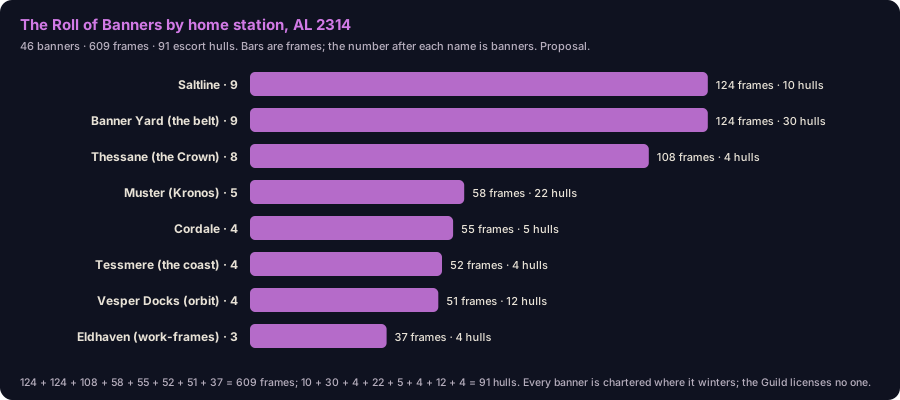
| Metric | Value |
|---|---|
| Banners | 46 on the Roll |
| Frames | About 609, of which Eldhaven's 37 are civil work-frames: fewer than half the Royal Frame Corps' 1,650 (the Crown almanac), about a quarter of the Imperial Frame Corps' 2,300 (the Vardane almanac), and nearly twice Homeguard's 322 |
| Hulls | 91 escort hulls, most of them in the belt and on the fuel run |
| Hands | About 1,500 licensed combat pilots, about 2.5 to a frame, as in the Royal Frame Corps |
| Banner-folk | About 22,000 on Kethra and in orbit: hands, ground crews, hull crews, the Hall and their households |
| People under Guild flags | About 43,000: the 22,000 on Kethra and in orbit, Banner Yard's 8,000 and Muster's 13,000 |
| Dead in service, 2149–2314 | About 3,100, by the Roll's count. Most in the Corridor War. |
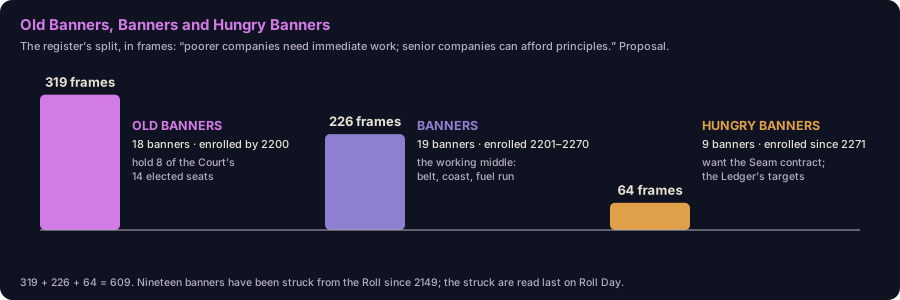
| Standing | Banners | Frames | Notes |
|---|---|---|---|
| Old Banners (enrolled by 2200) | 18 | 319 | "Senior companies can afford principles" (the register). They hold the Court. |
| Banners (2201–2270, and two since) | 19 | 226 | The working middle: the belt escorts, the coast, the fuel run. Two enrolled after 2270 and were free of their guarantors at once: the Tide Pennon, on Vesper's retainer from its first season, and the Corridor Pennon. |
| Hungry Banners (since 2271, still under a guarantor's bond) | 9 | 64 | "Poorer companies need immediate work" (the register). The Seam contract's advocates, and the Ledger's targets. |
The hands#
- Licensed like any pilot: a state licence and an Accord registration number (Chapter II), with a socket fitted at the licensing state's clinic under Ilyr's Accord licence and inspection (the Ilyr almanac); the frame-licence minimum age is 17 (Chapter I). The Guild adds its own Roll examination at the Salt Field, which no state recognises and every client asks for.
- Where they come from: the Crown's Commons and Unsonged, for whom "military service is the main path up" (Chapter II) and a banner is a second one; Line-born; belt crews; coast people; a few Imperial Citizens who left the Corps, whose sockets are Kessard's design and carry an Accord registration number like any other (the Assembly almanac), and no Bonded, who "are exempt from arms" (the Vardane almanac).
- The phantom frame (Chapter I) and socket scarring mark the old hands. Guild hands fly more hours than any state's, because a banner that is not flying is not paid.
- Black sockets end a hand's Roll record for ever. The Guild has struck three banners for them (2262), and has never let one fly.
| By origin | Share |
|---|---|
| Caldren Crown | 34% |
| Line-born | 22% |
| Belt-born and Upwellers | 17% |
| Coast states | 9% |
| Lesser Crowns | 8% |
| Eldvangers | 5% |
| Imperial Citizens | 4% |
| Others | 1% |
Language#
- Linecant at the Hall and in every contract's margins (Chapter IV); Hallspeech in the contracts themselves, because the Crown's courts read them.
- Link-cant, the pilots' speech (the Homeguard almanac), with the Guild's own words: a hand (a licensed pilot), hired (under contract; honourable), bought (owned; the insult), the Roll (the Guild, and a hand's record on it), struck (expelled), the black line (the line through a struck banner's name), a season (a contract term), the retainer (pay for not flying: "on the retainer" means idle), whose banner? (any question of loyalty).
Religion & Belief Systems#
The Guild observes every faith its hands bring. By declaration: the Cantorate 38%, Plain Reckoners 24%, no affiliation 21%, the Wolf Rite 9%, the Roll of Service 5%, other 3%.
- The Frame-oath, "My hand in every stride", is sworn by every licensed pilot (Chapter V); a Guild hand swears it twice, once to the state and once at the Salt Field to the Roll.
- The Day of the Hand (4 Thaw), the Imperium's Iron Winter remembrance (the Vardane almanac), is kept at every Guild yard with a hand raised in the canopy, because the Guild's founders stood at the Sentinel Field.
- Roll Day (9 Reaping) is the Guild's own: the Roll-Call sung, the struck names read last, in silence.
Public Health#
| Pilots' health | Link fatigue, headaches, the phantom frame (Chapter I). The Guild's hands fly more than anyone's; the Salt Field's surgeons ground any hand whose socket is out of licence. |
| The belt | The Hollows and decompression, as for every belt crew (Chapter I, the Coalition almanac); Banner Yard keeps its own infirmary |
| The dead | A struck banner's dead are still the Roll's dead; the Serrin Nine are named on Roll Day |
Education#
| State schools first | Every hand is licensed by a state, and trained where the trade is taught: the Frame Licensers in the Crown (Chapter VI); the League's Wick Pilots' School for belt-born hands (the League almanac), who then take the Coalition's licence, because the League is no state; the Imperial Citizens came trained from Draemor (the Vardane almanac) |
| The Salt Field | The Guild's own trials and examination: two seasons, and a Roll record at the end of it |
| The Court's clerks | The Guild's other trade: contract clerks trained at the Saltline Exchange (the Line almanac), who write the exit clauses |